
You’re standing at a delivery counter, ballpoint pen in hand, scribbling your name on a little plastic screen that barely works. You sign without really looking, like you always do. A quick line. A flourish. Or that habit you have of dragging a long, confident underline beneath your last name, as if you’re signing something way more important than a package from the mailman.
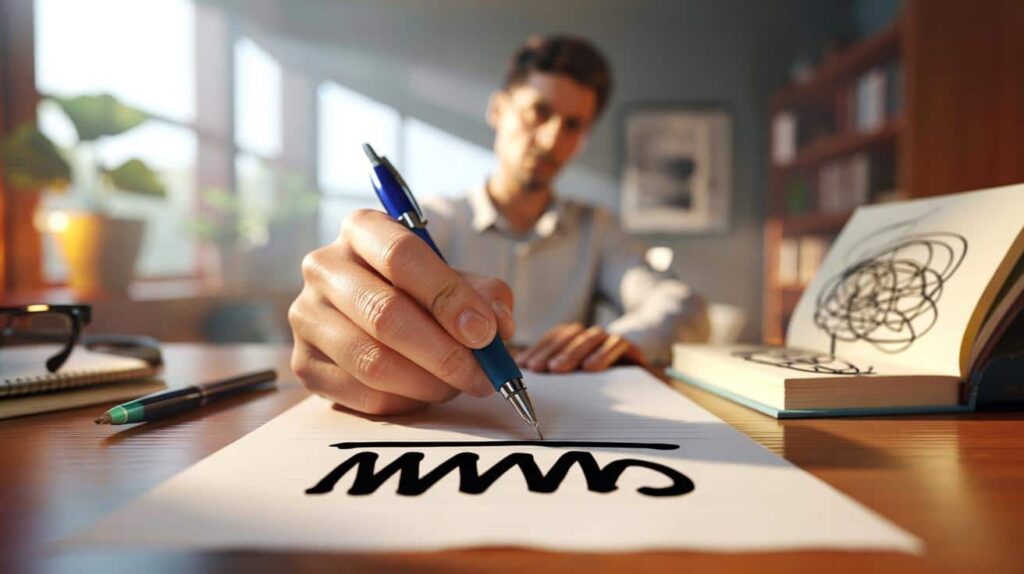
The clerk doesn’t notice.

But a psychologist watching over your shoulder would.

Because that simple underline, that extra gesture you think is just “your style”, can say a lot about the way you see yourself, your place in the world, and even how safe you feel inside your own skin.

Your name is one thing.
What you draw under it may be something else entirely.
What the underline in your signature quietly says about you
Handwriting experts have been studying signatures for decades, and the underline is one of the first details they look at. That extra stroke isn’t neutral. It’s loaded with self-image, ego, and sometimes a hidden need to be seen.
People who underline their name often feel a strong desire to affirm their identity. It’s like they’re putting a spotlight under their own presence on the page.
Some do it with a straightforward line, clean and simple. Others go for loops, zigzags, or long, dramatic tails shooting off into space.
Each tiny variation whispers something slightly different.
Picture two colleagues signing a birthday card at the office.
Emma signs “Emma” in small, rounded letters, no underline, almost pressed into the corner. She smiles, steps away. Then Marco takes the pen. He writes his full name in big, leaning letters, and drags a thick, rising underline under his surname, almost cutting through the printed message.
Nobody comments, because we rarely talk about this kind of thing out loud. Still, the difference jumps out.
Psychologists who work with graphology say these habits rarely appear by accident. They’re built over years, like a tiny visual ritual that follows you from school notebooks to rental contracts and digital pads at the bank.
In psychological terms, the underline often acts as a form of self-support. It’s like telling the world, *“Here I am, this is me, read this name properly.”*
A straight, balanced line under the full name tends to be linked with a stable sense of identity and a clear wish to be recognized, but not necessarily adored. A long, thick, rising underline, especially under the last name, can signal stronger ambition, pride, or a push to “elevate” one’s social image.
On the other hand, a broken, hesitant, or wavy underline may hint at doubts. The person wants to boost their presence but doesn’t fully trust their own place.
The pen says both “notice me” and “please don’t look too closely.”
Different underlines, different inner stories
If you’re curious about your own signature, the first step is simple: write it down the way you normally would. Don’t overthink it. Just sign as if you were confirming a delivery or paying by card at the supermarket.
Then look only at the underline.
Is it straight or curved? Thick or light? Long or short? Does it start before your first letter, or after your last? Each of these choices, repeated over hundreds of signatures, creates a sort of psychological fingerprint.
This isn’t a magic test. It’s more like a mirror you rarely look into.
Psychologists and graphologists often describe a few recurring patterns. A straight, short line directly under the name suggests someone who wants a basic level of recognition, without too much drama. They want to be taken seriously, not necessarily to be the star of every room.
A long line that starts before the first letter and ends after the last can point to a stronger ego, a taste for control, or the wish to “frame” their identity in bold. When that line rises at the end, some experts read it as ambition and optimism. When it drops sharply, they may see fatigue, pessimism, or internal conflict.
Then there are those who add loops, curls, or double underlines. That often signals theatricality, a need for emphasis, sometimes a craving for admiration.
 When kindness becomes isolating: 7 reasons “nice women” have fewer friends as they get older
There’s also the question of what exactly you’re underlining. Many people only underline their family name. That can suggest a strong connection to heritage, status, or the social dimension of identity. It may point to someone who measures their worth in achievements, roles, or titles.
Others underline their first name instead, or both names together as a single block. That can reflect a more personal, relational vision of the self, where intimacy and emotional bonds matter more than public image.
And then some people used to underline their signature as teenagers and gradually stopped. That quiet change can mirror a real internal shift: less need for external validation, more comfort with anonymity, or simply less energy spent on how they appear.
Let’s be honest: nobody really analyses this every single day.
How to read your underline without freaking out
If you’re tempted to decode your signature like a secret file, take a breath. The most useful approach is playful curiosity, not panic. Start by collecting a few real-life samples: your ID, an old schoolbook, a signed contract, a parcel receipt.
Compare them. Has your underline changed over time? Did it get thicker during a stressful job, longer during a confident period, or vanish completely after a big life shift?
Look at how much pressure you use on the page. A strong, heavy line can suggest intensity, determination, or tension. A barely visible line may hint at discretion, fatigue, or a reluctance to “impose” yourself.
None of this is a sentence. It’s a conversation starter with yourself.
There’s a common trap here: reading every detail as a flaw. You see a wobbly line and think, “So I’m insecure, great.” You spot a bold underline and think, “Wow, I must be narcissistic.”
Reality is usually less dramatic. Traits overlap. People are both proud and anxious, ambitious and shy, depending on the day. Your signature reflects tendencies, not fixed labels.
If you notice a very theatrical underline, you might simply ask: “Where in my life do I feel unseen?” If your line is tiny or fading, the question might be: “Where do I hold back more than I’d like?”
Small questions, gentle answers. No self-diagnosis required.
Another thing professionals quietly remind people of: context matters. Culture, schooling, and even your first pen can shape how you sign. Some countries teach kids to underline their name by default, as a sign of neatness.
So one plain-truth sentence is needed here: **no serious psychologist will judge your entire personality from one line of ink.**
Still, that doesn’t mean your underline is meaningless. It’s one clue among many, and it can highlight what you tend to emphasize in yourself.
“Handwriting doesn’t reveal fate,” says one graphology specialist, “but it can reveal habits of thought — and habits can be changed.”
- Observe your underline — length, pressure, direction, and where it starts and ends.
- Compare past and present signatures — notice any slow, natural changes over the years.
- Connect patterns to life phases — big jobs, breakups, moves, or identity shifts.
- Use what you see as a prompt — not a verdict, just a question about how you feel today.
- Experiment gently — adjust your signature only if it feels like growth, not a costume.
Letting your signature evolve with who you are
Once you’ve noticed your underline, you might feel a strange urge: to change it. To straighten it, soften it, shorten it, or erase it completely. That’s not necessarily a bad thing.
Our identity isn’t frozen. Careers, relationships, health scares, therapy, burnout, parenthood — everything we live through leaves a trace, and sometimes that trace runs through our handwriting.
Some people report that after a big personal shift, their signature no longer “felt right”. The old, loud underline didn’t match the quieter, more grounded person they’d become. Others did the opposite: they started underlining their name after years of staying small, as if their hand finally caught up with their voice.
You don’t have to reinvent your signature overnight. You can play with it, like trying on different coats in front of a mirror. A lighter line, a more fluid curve, a slightly shorter stroke. Feel what happens in your body when you sign that way a few times.
Sometimes you’ll feel silly. Sometimes you’ll feel strangely relieved.
And maybe that’s the whole point. Not to turn your underline into a performance, but to notice whether the way you present your name still matches the person carrying it.
Your passport won’t tell the full story. Your email address won’t either. Yet that tiny line under your name, repeated day after day, might quietly reveal how much room you allow yourself to take on the page — and in your own life.
| Key point | Detail | Value for the reader |
|---|---|---|
| Underline as self-image | The style, length, and pressure of the line can reflect how you see your place in the world. | Gives a simple lens to explore confidence, ego, and identity. |
| Changes over time | Shifts in your underline often appear during major life transitions or emotional phases. | Helps you track personal evolution in a concrete, visual way. |
| Tool, not verdict | Graphology offers clues, not rigid labels, and must be read in context. | Protects you from overinterpreting while still inviting self-reflection. |
FAQ:
- Question 1Does underlining my signature automatically mean I’m narcissistic?
- Question 2Can changing my underline really change my personality?
- Question 3What if my signature has no underline at all — does that say anything?
- Question 4Are digital signatures on screens or apps still meaningful psychologically?
- Question 5Is graphology recognized as a solid science by psychologists?
