
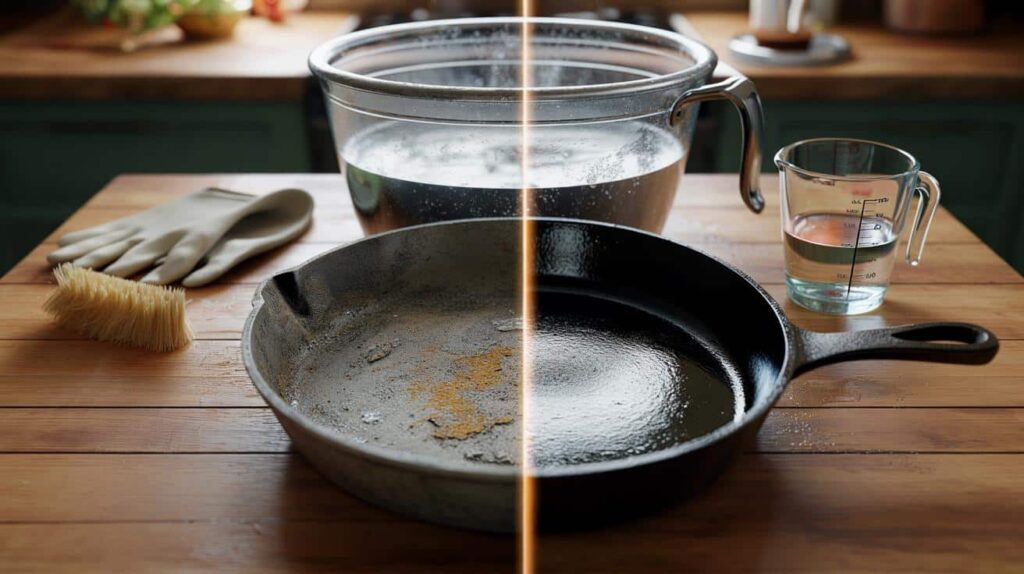
The pan had belonged to my grandmother, and it looked like it had lived several lives. The bottom was dull and gray, the surface rough as sandpaper, with little patches of orange rust creeping in from the edges. I’d promised myself for months I’d “deal with it one day,” then stuffed it back in the cupboard, slightly guilty, slightly annoyed.
One Saturday morning, after another fried egg welded itself to the metal, I finally snapped. I started scrolling through forums, old cookbooks, even those dusty corners of the internet where people argue about bacon fat like it’s politics. That’s where I saw it mentioned, almost casually: a forgotten soak that supposedly brings cast iron back from the dead.

A soak that doesn’t involve hours of scraping, mystery chemicals, or crying over lost seasoning.

The quiet enemy that ruins cast iron (and what no one tells you)
If you’ve owned a cast iron pan for more than a year, you’ve probably seen it: that slow decline from glossy black to tired gray. The surface gets sticky, food starts clinging in odd patches, and suddenly you’re wondering if non-stick wasn’t such a bad idea after all.

Most people blame themselves. Not enough oil, too much soap, too high heat. The pan becomes a symbol of “I don’t know what I’m doing,” so it gets pushed further and further back on the shelf. The truth is quieter and less dramatic. Cast iron rarely dies from one big mistake. It dies from tiny, repeated ones.
Take Mia, a home cook in her thirties who swore she was “bad with cast iron.” She rinsed her pan with hot water, wiped it, even rubbed a bit of oil on it some nights. Yet every few weeks, the same thing happened: sticky spots, dull patches, a faint metallic smell. She thought she’d “ruined the seasoning” and kept starting over from scratch in the oven.
What she didn’t realize was that small layers of old oil, soap residue, and microscopic rust were quietly building up. A kind of invisible gunk. Not enough to scream “disaster,” just enough to sabotage every fried egg and pancake, making her feel like the problem was her, not the pan.
There’s a technical side to this story, even if it hides underneath everyday frustration. That black, shiny surface we call “seasoning” is really just polymerized oil — oil that’s been transformed by heat into a hard, slick layer. When it’s clean and intact, cast iron behaves like magic.
But when that layer gets clogged with half-burnt oil, soap films, or tiny rust blooms, the pan stops being non-stick and starts acting… moody. Food bonds with the rough patches instead of gliding over them. Water clings. Smells linger. And *no amount of quick wiping can fix that kind of buildup.* This is where the forgotten soak comes in.
The forgotten soak: how a simple lye bath revives cast iron
The method sounds almost too simple: a lye soak. Old-school collectors and serious restorers use it when they find pans at flea markets that look beyond saving. The idea is straightforward. You submerge the pan in a diluted lye solution for several days. The lye gently eats away years of baked-on grease, sticky residue, and failed seasoning, without grinding the metal itself.
When the pan comes out, every trace of old seasoning is gone. What you’re left with is raw, bare cast iron — a clean slate. **Not ruined. Not weakened. Just stripped back to zero.** Then you can season it again, properly, like breathing new life into a tired tool your kitchen secretly misses.

If that sounds scary, you’re not alone. The word “lye” tends to send people running, imagining burning skin and horror stories. But used correctly, in a plastic tub with gloves and glasses, it’s way less dramatic than hours of sanding and oven fumigation.
The most common mistake people make is trying to rescue cast iron only with elbow grease: scraping with metal spatulas, scrubbing with steel wool until their fingers ache, then blasting it in the oven at extreme heat. That often leaves a patchy surface and doesn’t fully remove the deep layers of polymerized gunk. It’s like wiping the table but never really cleaning the sticky spot in the corner. *Let’s be honest: nobody really does this every single day.*
Sometimes the simplest tools are the ones we quietly stopped talking about. As one seasoned restorer told me, “A lye bath is like pressing reset on a pan’s lifetime. People think their cast iron is ruined, but it’s usually just dirty in a way you can’t see.”
- Use a sturdy plastic bin, big enough for your pan to lie flat.
- Mix a lye solution: typically about 1 tablespoon of pure lye per liter of water, always adding lye to water, never the other way around.
- Wear gloves and eye protection, and keep the bin somewhere pets and kids can’t reach.
- Submerge the pan completely and leave it for 2–7 days, checking occasionally.
- Rinse thoroughly, scrub with a brush, then dry and move on to seasoning with thin layers of oil.
From orange rust to satin black: what happens after the soak
When you pull the pan out of the lye bath, it won’t look magical right away. The surface will likely be a flat, gray metal, with some orange rust appearing almost instantly as the water hits it. That’s normal. That’s just bare iron meeting air. At this point, many people panic and think they made it worse. They didn’t. They just revealed what was hiding underneath.
This is where a second, shorter step often comes in: a quick vinegar soak or scrub, to tackle surface rust. A mix of water and regular white vinegar, about half and half, for 30 minutes to an hour, then a firm brush-down. Any longer and the vinegar can start biting too much into the metal, so this is not an overnight job.
Once the rust is handled, the pan looks almost shockingly naked. You can see casting marks again, little imperfections, details you forgot were there. That’s the moment you understand the whole point of this forgotten soak: it brought you back to the beginning, when the pan first left the factory.
From there, the seasoning process feels different. You’re no longer endlessly layering oil on top of old, compromised layers. You’re building from scratch. Thin coatings of oil, wiped nearly dry, baked at high heat. One layer, then another, then another. Slowly, the gray turns to brown, then a calm, deep black. **You can literally see the surface tightening and smoothing with each round.**
What’s interesting is how emotional it can feel. This isn’t just about restoring an object. It’s about confronting the quiet guilt we carry about not “taking proper care” of our things, then discovering that sometimes the answer isn’t more effort every day. It’s one bigger, smarter reset every few years.
We’ve all been there, that moment when a tool we loved starts failing us and we quietly blame ourselves. The lye soak shifts that story. It says: your pan isn’t a lost cause, you’re not incompetent, you just need the right process. And once you’ve seen a rusty, flaky skillet come back to a smooth, black, almost mirror-like finish, you start looking at other “lost causes” in your kitchen a little differently.
| Key point | Detail | Value for the reader |
|---|---|---|
| Deep-clean with a lye soak | Strips old seasoning, grease, and residue without grinding metal | Restores even, reliable cooking surface |
| Follow with brief vinegar treatment | Short rust-removal step after lye bath | Prepares truly clean iron ready for fresh seasoning |
| Rebuild seasoning in thin layers | Multiple light coats of oil, well baked, not slathered | Creates durable, smooth, black non-stick finish |
FAQ:
- Isn’t lye dangerous to use at home?It demands respect, not fear. Use gloves, eye protection, a plastic container, and follow basic handling rules. Many households already use products with lye; the difference here is you’re controlling the concentration and contact time.
- Can I skip the lye and just use vinegar or oven cleaning cycles?Vinegar only handles rust, not baked-on grease. Oven cycles can help but rarely remove all deep seasoning layers. The lye soak is designed specifically to dissolve old fats and residue thoroughly.
- Will a lye soak damage or thin my cast iron?Used at normal restoration strength and timeframes, lye doesn’t attack the iron itself. It targets organic material — oils, food, old seasoning — leaving the metal intact.
- How often should I do a full lye soak on my pan?Most home cooks never need it more than once every few years, sometimes only once in a lifetime of the pan. It’s a reset button, not a weekly cleaning routine.
- What oil should I use to reseason after the soak?Neutral, high-smoke-point oils like grapeseed, canola, or refined sunflower work well. The key is thin coats, wiped almost dry, and enough time in a hot oven for each layer to fully polymerize.
