
The oven door opened with that soft, sticky pull, and the entire kitchen changed. Steam rolled out in a lazy cloud, carrying a smell that was somewhere between Sunday lunch at your grandparents’ and the best restaurant you can’t quite afford. Someone’s playlist hummed from a phone on the counter, half drowned out by the quiet clatter of plates being set. Nobody was scrolling. Nobody was rushing.
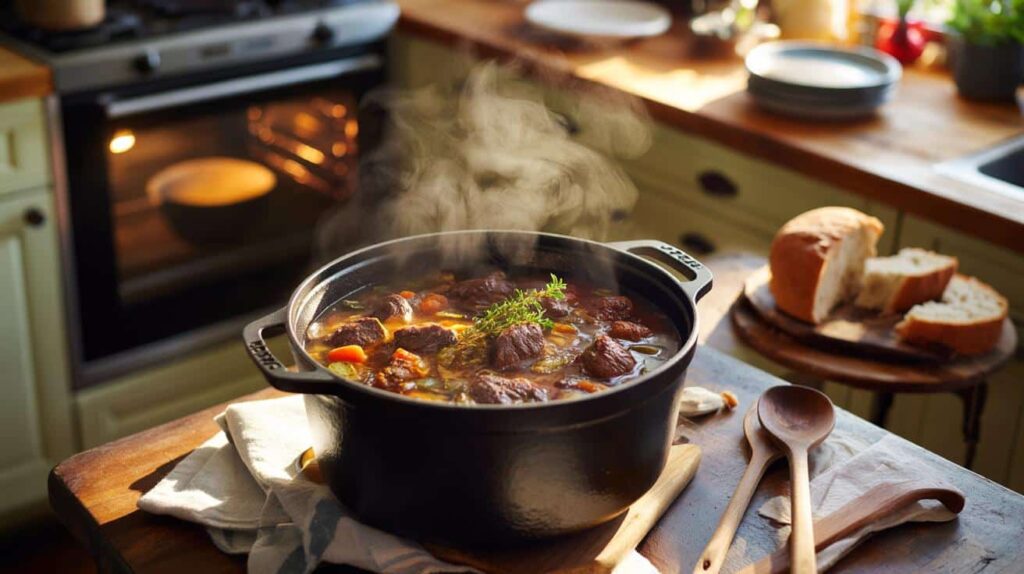
The slow-cooked dish on the middle rack had been there for hours, forgotten and watched at the same time. People wandered in, lifted the lid, stole a breath, walked away slightly happier.

Every home has one dish like that.

The kind of comfort you don’t forget.

The quiet power of a dish that waits for you
There’s something strangely calming about a pot that’s been in the oven since mid-afternoon. It’s not performance cooking. You’re not juggling three pans or sprinting between timers. The work is front-loaded, then the oven takes over and your home slowly fills with a promise.
You pass through the room and the smell hits you. A low, rich, slow smell that says, “You’re not alone, dinner is already happening.” The day might have been a mess, the news exhausting, the commute a battle, but this? This is under control.
*Food that waits quietly in the oven has a way of making the rest of life feel a bit less frantic.*
Picture this: a grey Tuesday, the kind that never really wakes up. You throw beef, onions, carrots, garlic, a splash of red wine and a stubborn sprig of thyme into a heavy pot at 2 p.m. Some stock, a little tomato paste, the kind of seasoning you do more by instinct than recipe. Lid on. Into the oven at a low heat.
You go back to your laptop, or your laundry, or just lying on the couch doomscrolling because, well, you’re human. Two hours later, the air has changed. By hour three, neighbors coming up the stairs can smell it. By hour four, the meat is barely holding itself together, the sauce thickened into something that looks like comfort poured over itself.
You lift the lid and suddenly the whole day feels like it had a point.
Dishes like this work on a different timeline than the way we usually eat now. No delivery driver racing the clock, no 15‑minute “hack” meal you half-watch on your phone while chewing. Long oven cooking breaks that urgency. The low heat breaks down collagen, melts fat slowly, coaxes sweetness from onions and carrots that were pretty dull at the start.
Scientifically, it’s just moisture, heat, and time doing their job. Emotionally, it’s a reminder that some things get better precisely because they took longer than you thought you had. The flavors deepen, the sauce thickens, and so does the feeling that maybe you’re allowed to slow down too.
Let’s be honest: nobody really cooks like this every single day. That’s exactly why it feels special when you do.
How to build that unforgettable slow-oven comfort
The basic method is beautifully simple. You start with a tough cut of meat or a hearty vegetable base that can take the heat: beef chuck, lamb shoulder, chicken thighs, or even big wedges of cabbage or squash. Brown them quickly in a little oil on the stovetop to get that dark, caramelized layer on the outside. That’s your flavor foundation.
Then you throw in your aromatics: sliced onions, crushed garlic, maybe a bit of celery or leek if it’s hiding in the fridge drawer. A spoon of tomato paste, a shake of herbs, some salt. Deglaze with wine, stock, or even just water, scraping up every browned bit stuck to the bottom.
Once it’s all in the pot, lid on. Into the oven at a low temperature, somewhere between 275°F and 325°F (135–165°C), and you walk away while it turns itself into memory.

Most people go wrong on three things: oven too hot, not enough liquid, not enough time. You rush it and the meat stays tense, the vegetables dry out, the sauce never quite becomes that glossy, clinging blanket you were hoping for. The oven should feel lazy, not aggressive.
There’s also the seasoning panic. At the start, everything tastes flat, so you’re tempted to dump in salt and spices like you’re trying to fix your whole life in one go. Then, hours later, it’s too salty, too intense, and you’re disappointed. Start gently, then taste again near the end when the flavors have settled into themselves.
We’ve all been there, that moment when you lift the lid and think, “Oh no, I ruined it.” You probably didn’t. A splash of acidity and a little patience can rescue more than you’d expect.
“Low and slow cooking is like a conversation,” says Elise, a home cook who works nights and preps her meals in the morning. “You say a little at the start with your ingredients, then you let the oven talk back over time. By dinner, you’re both saying the same thing: stay a while.”
- Start with the right cut
Look for tougher, cheaper cuts or sturdy vegetables that can handle hours in the oven. They’re built for transformation, not speed. - Build layers of flavor early
Brown your meat and veg, use aromatics, and deglaze the pan. Those small steps pay off later when the sauce tastes like it cooked longer than it actually did. - Let time do the heavy lifting
Resist the urge to open the oven every 10 minutes. Each time you peek, you lose heat and momentum. Trust the process more than you trust your timer. - Finish with brightness
A squeeze of lemon, a spoon of yogurt, chopped herbs, or a drizzle of olive oil at the end wakes the whole dish up. Comfort food doesn’t have to be heavy to feel deep. - Cook once, remember twice
These dishes taste even better the next day. Future-you will be very grateful for past-you’s laziness and foresight.
The kind of comfort people remember years later
Ask people about the meals they remember and they rarely talk about perfect plating or complicated sauces. They talk about the stew that waited for them when they came home from the hospital. The casserole that fed five friends off one cheap tray when everyone was broke but nobody said it out loud. The braised chicken that made a tiny apartment smell like a real home.
These slow oven dishes quietly collect stories around them. They stretch when one more guest shows up. They forgive timing mistakes when someone is late. They sit on the table, heavy and generous, inviting second helpings and long conversations that drift long past the last bite.
A pot that has been in the oven for hours doesn’t just feed hunger. It reassures. It signals care, even if you were tired and winging it and using whatever you had in the fridge.
You don’t need a Dutch oven that costs half a paycheck or rare spices you can only find in another country. You can do this with a battered roasting pan, some foil, a basic oven that runs slightly too hot on one side, and ingredients from the discount section. The magic is time, not price.
Maybe your version is a slow-baked pasta with too much cheese, or a tray of vegetables that turn sticky and sweet under low heat, or a braised chicken that falls off the bone before you even touch it. There’s no single correct recipe for this kind of comfort. There’s just the one that feels like yours.
These are the meals people ask you for the recipe of, then never quite reproduce, because what they’re really trying to replicate is the feeling.
One day, someone you love will say, “Remember that thing you made that time? That one from the oven that smelled like… everything good?” And you’ll know exactly which dish they mean. It won’t be the quickest thing you ever cooked, or the prettiest, or the one that got the most likes. It’ll be the one that turned a regular day into something that softened at the edges.
You might cook it again and again, slightly differently each time. Sometimes with wine, sometimes without. Sometimes with potatoes, sometimes with bread to mop the plate. Life will change around it: jobs, homes, people at the table. The recipe will barely notice.
And every time you open the oven and that wave of warmth hits you, you’ll remember: some comforts are worth waiting for.
| Key point | Detail | Value for the reader |
|---|---|---|
| Low and slow wins | Use a gentle oven temperature and give the dish several hours | Transforms cheap ingredients into deep, memorable flavor |
| Build flavor early | Brown ingredients, add aromatics, deglaze the pan | Makes the final dish taste richer without extra effort at the end |
| Finish with contrast | Fresh herbs, acidity, or a creamy element right before serving | Prevents heavy dishes from feeling dull and keeps comfort food exciting |
FAQ:
- Question 1How long should a slow oven dish usually cook?
- Answer 1Most slow oven dishes need between 2.5 and 4 hours at 275–325°F (135–165°C), depending on the cut of meat or density of the vegetables.
- Question 2Can I make a slow oven comfort dish without meat?
- Answer 2Yes. Root vegetables, beans, lentils, and whole heads of garlic or cabbage turn silky and deep-flavored with the same method.
- Question 3Do I need a Dutch oven for this kind of recipe?
- Answer 3No. Any oven-safe pot with a lid, or even a roasting pan tightly covered with foil, will do the job.
- Question 4How do I stop my slow dish from drying out?
- Answer 4Add enough liquid to come about one-third up the ingredients, keep it covered most of the time, and check once midway to see if it needs a splash more.
- Question 5Why do these dishes taste better the next day?
- Answer 5As the dish cools and rests, flavors meld and intensify, and the texture often improves, which is why leftovers can feel almost more comforting than the first serving.
