
The first thing you notice isn’t the cold. It’s the silence.
On a wind-scraped stretch of Arctic coastline, the usual winter soundtrack — the bark of seals on ice, the wingbeats of guillemots, the distant crack of sea ice — is strangely muted. A low gray sky hangs over a patchwork of open water and slushy, half-formed floes where a solid white sheet once held steady until spring.
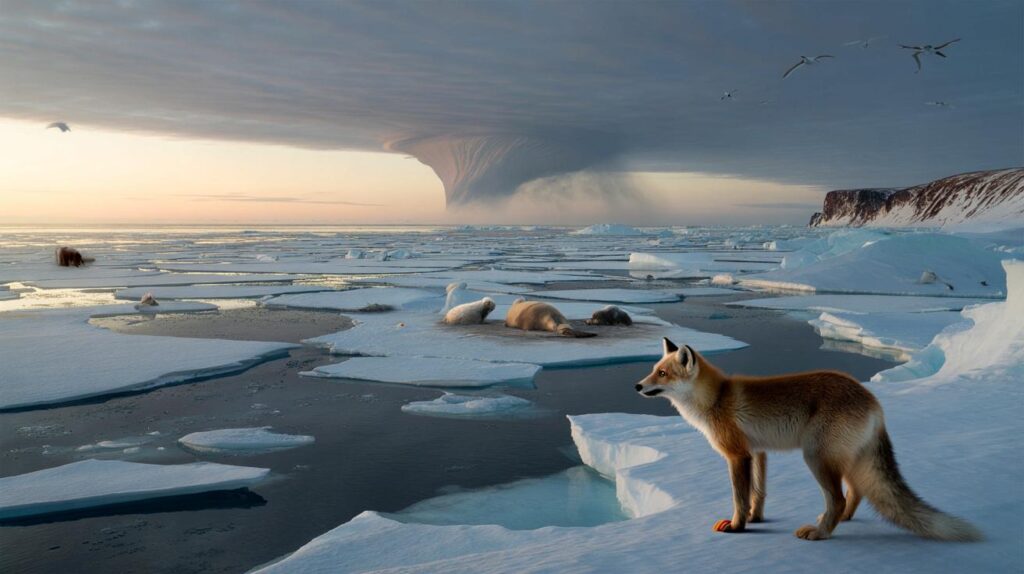
A polar fox pads cautiously along the shore, nose twitching, searching for a scent that should be there and isn’t.
Meteorologists checking their early February models glance at the screens, then glance again. Numbers are off, patterns are skewed, the jet stream looks like spilled ink.
 Parents who say they love their kids yet refuse to do these 9 things are pushing them away
Something has shifted.
And this winter, scientists are starting to say the quiet part out loud.

When the Arctic calendar suddenly breaks
Early February used to be the Arctic’s deep freeze, a dependable anchor in a brutal but predictable year.
Now meteorologists tracking temperature anomalies say the “anchor” looks more like a loose rope. Sea ice forms later, melts earlier, and spends more weeks in a fragile in-between, riddled with cracks and pools of open water.
For human eyes, those changes can look subtle on satellite images: a few darker patches here, a thinner band of white there.
For animals tuned to millennia-old seasonal cues, they’re more like someone scrambling the calendar overnight.
Migrations shift, breeding seasons fall out of sync, and hunting grounds move hundreds of kilometers in a single decade.
One Arctic birder in northern Norway describes watching puffins return to cliffs that look the same at first glance — dizzying, dramatic, familiar — yet hide a quiet crisis.
The birds arrive on time, but the fish they rely on are late, or have slipped north chasing cooler water. Tiny chicks wait in rocky burrows while parents fly further, spend longer, burn more energy. Some simply don’t make it back.
On the ice, biologists tracking polar bears report more bears turning up near villages, rummaging in dumps, leaner and more desperate.
One team following denning females found that several traditional den sites, once safely buried under snow and ice, were suddenly exposed to warm winds and rain in early February storms, collapsing roofs that should have held for weeks.
This is why scientists keep using a phrase that sounds abstract but carries a sharp edge: “biological tipping point.”
Animals and ecosystems can absorb a certain amount of wobble — a weird warm spell, a bad breeding year, a late freeze. They stretch, adapt a little, and bounce back.
But when Arctic weather changes so fast that early February feels like late March, those natural buffers begin to tear.
Food chains built on precise timing start to misfire. Predators arrive before prey. Calves are born on ice that doesn’t yet exist or already broke apart.
That tipping point is less like a cliff and more like black ice: you only realize you’ve hit it when the slide has already begun.
How scientists read the warning lights — and what it means for us
Meteorologists are not just watching thermometers; they are reading a complicated, moving puzzle.
In early February, they track high-altitude winds, sea-surface temperatures, and pressure systems that twist over the Arctic like slow-motion whirlpools.
One of the key warning lights this year is the behavior of the polar vortex, that ring of cold air circling the pole.
When it weakens or wobbles, heat surges north, sea ice doesn’t harden as it should, and storms carry warm, wet air straight into the deep freeze.
Those disruptions ripple across the globe, but in the Arctic, they rewrite the survival script for everything from plankton to caribou.
We’ve all been there, that moment when winter suddenly feels “wrong” — rain instead of snow, a thaw that kills off the last of the ice.
For Arctic animals, that “off” feeling is a matter of life or death. Reindeer herders in parts of Scandinavia talk about rain-on-snow events that seal ground lichen under a glassy crust. The herds smell food but can’t dig through the frozen shell.
Calves weaken, adult reindeer burn precious energy, and herders find carcasses where healthy animals should be.
Farther north, walruses are forced onto crowded beaches because the sea ice platforms they once used as resting spots have retreated beyond reach.
Crowding leads to deadly stampedes, especially when spooked by planes, ships, or even drones.

*Let’s be honest: nobody really reads climate bulletins every single day.*
People are busy, tired, and juggling their own storms. The Arctic can feel distant, like a screensaver of icebergs and auroras.
Yet the language scientists are using this year is noticeably sharper.
Some speak of “ecological upheaval,” others of “runaway feedbacks” — processes where melting ice uncovers dark ocean, which absorbs more heat, which melts more ice.
“The concern,” explains marine ecologist Dr. Lena Sørensen, “is that animal populations don’t just decline neatly and slowly. They can hang on, seem stable enough, and then, once stress passes a certain point, they crash. That’s the tipping point we’re picking up hints of in early February data.”
- Later-forming sea ice – Shortens hunting seasons for top predators and narrows the breeding window for seals.
- Warmer winter storms – Soak snow dens, flood burrows, and expose young animals to deadly chill after the melt-refreeze cycle.
- Shifting ocean currents – Push plankton and fish into new zones, leaving traditional feeding areas eerily empty.
- Jet stream distortions – Send “freak” weather south, affecting crops, floods, and heatwaves far from the Arctic.
- Permafrost thaw – Releases methane and carbon, locking in more warming for decades ahead.
Living with a tipping point that hasn’t fully tipped — yet
There is a strange tension in talking about a biological tipping point while animals still roam, birds still nest, and ice still glows under low winter sun.
The catastrophe is not total, not everywhere, not all at once. That can make it easier to look away — and harder for those sounding the alarm to be heard.
Some researchers now speak quietly of “triage,” focusing on species and regions where action can still bend the curve.
That might mean protecting key breeding grounds, reducing ship traffic along sensitive coasts, or giving Indigenous communities legal power to defend the frozen landscapes their cultures are bound to.
For many Arctic residents, this isn’t a science headline; it’s the backdrop of daily life.
Hunters study thinner ice not on a laptop model, but under their boots, testing each step with a stick where their grandparents drove dog sleds without a second thought.
When an early February thaw breaks trails or floods cabins, it’s not about degrees on a graph. It’s about food security, cultural continuity, and basic safety.
There’s a quiet grief in these stories, but also a stubborn creativity: shifting migration routes, new safety protocols, hybrid livelihoods that mix traditional knowledge with satellite apps and real-time ice maps.
Scientists, for their part, are learning to talk differently, less like cautious referees and more like people watching a slow-motion pile‑up.
They still hedge, because that’s how science works, but the outlines are clear: an Arctic that once buffered the planet’s climate is now amplifying the chaos.
The plain-truth sentence hanging over this winter is simple: **what happens in early February above the Arctic Circle does not stay there**.
Weather patterns twist south. Food systems feel the strain. Insurance companies quietly adjust their risk models.
What’s left is a question we don’t quite know how to ask in everyday terms:
How do you live, vote, travel, eat, and care in a world where the far north is quietly crossing a line you can’t see, but will definitely feel?
| Key point | Detail | Value for the reader |
|---|---|---|
| Early February is no longer reliably “deep winter” in the Arctic | Temperature anomalies, unstable sea ice, and disrupted polar vortex patterns are showing up in meteorological data | Helps you understand why weather feels weirder and less predictable, even thousands of kilometers away |
| Arctic animals are approaching a biological tipping point | Mismatched timing between predators and prey, collapsing dens, and altered migrations push species toward sudden declines | Makes clear what is at stake beyond abstract “climate change” talk — real impacts on living beings and food webs |
| Today’s Arctic shifts are tomorrow’s global shocks | Changes in ice, ocean currents, and jet stream behavior can drive extreme weather, crop failures, and economic instability elsewhere | Shows why paying attention now can inform personal choices, political pressure, and long-term planning |
FAQ:
- Question 1What exactly do scientists mean by a “biological tipping point” in the Arctic?
- Answer 1They mean a threshold where wildlife populations and ecosystems stop responding gradually to stress and instead shift abruptly. Numbers may look stable for years, then plunge once food, habitat, or timing slip beyond what animals can adapt to.
- Question 2Is this only about polar bears, or other species too?
- Answer 2Polar bears are a visible symbol, but they’re just one part of a much larger web. Seals, walruses, seabirds, reindeer, plankton, and fish are all affected by changing ice, currents, and weather patterns in early and late winter.
- Question 3How do meteorologists know early February patterns are changing?
- Answer 3They compare decades of temperature, sea ice, and atmospheric data. Recent winters show consistent anomalies: thinner ice, warmer air intrusions, and altered jet stream behavior that didn’t appear in older records at this scale.
- Question 4Does this Arctic shift really affect everyday weather where I live?
- Answer 4Yes, though the link can be complex. Changes in the polar vortex and jet stream can influence heatwaves, cold snaps, storm tracks, and rainfall patterns across North America, Europe, and Asia, sometimes weeks or months later.
- Question 5Is there anything practical an individual can do about a problem this huge?
- Answer 5You can’t “fix” the Arctic alone, but personal choices add up: voting for climate‑focused policies, reducing fossil fuel use, supporting Indigenous‑led conservation, and staying informed so the tipping point conversation doesn’t vanish between news cycles.
