
The kettle whistles in the cramped little kitchen while the radio softly mutters yesterday’s news. At the table, a tiny woman in a cardigan the color of sage leaves is buttering toast with the care of a jeweler cutting diamonds. Her hands are veined, a bit shaky, but fiercely precise. This is Marie, 100 years old, living alone in the same small house she moved into as a young bride. No carers ringing the doorbell. No institutional smell of disinfectant. Just her, her plants on the windowsill, and the stubborn rhythm of her daily habits.
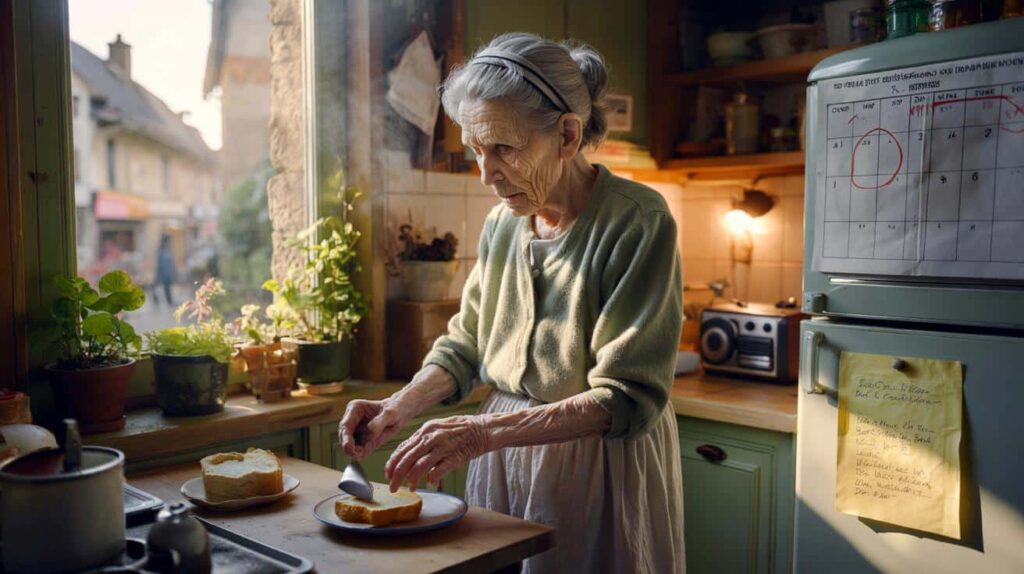
When I ask what keeps her going, she laughs so loud the spoon on her saucer trembles. “I refuse to end up in care,” she says, eyes suddenly sharp. “So I live like someone who doesn’t.”

Her routine is simple. Her discipline is not.

The centenarian who still plans her own day
Marie starts each morning the same way: feet on the floor before 7, curtains wide open, window cracked no matter the season. She sits on the edge of the bed for a moment, checking in with her body like a pilot before take-off. “Can I stand? Can I walk? Yes? Then I will.” That’s her logic. She puts on real clothes, never pajamas all day, and ties her thinning grey hair into a neat bun.

She calls it “showing up for life”. No special gadgets. No biohacker smoothie. Just a quiet refusal to slide into passivity.
The numbers back her up. Studies from so-called “blue zones” – those rare regions where people regularly live past 100 – show a similar pattern: consistent daily movement, a purpose that lasts beyond retirement, and social ties that don’t fade with age. In Okinawa, older women meet for “moai” circles. In Sardinia, men in their nineties still walk hilly streets instead of sitting all day.
Marie doesn’t know any of this research. She just walks to the corner bakery each morning, leaning on her cane, chatting with the same baker she has known for forty years. That ten-minute walk, that short conversation about the weather or the price of cherries, is her living proof that the outside world still has a place for her.
There’s a logic in her habits that feels almost old-fashioned. By keeping a structure, she keeps her autonomy. By doing small things herself, she stretches the muscles of independence a bit longer. She eats at fixed times, takes her pills with breakfast, writes appointments on a big paper calendar instead of trusting her memory. It looks simple, even boring. Yet this routine is her invisible exoskeleton.
We like to imagine longevity hanging on miracle diets and DNA. Marie’s life suggests something less glamorous and more demanding: a stubborn series of tiny, daily choices that say “not yet” to dependency.
The small daily rebellions that keep her out of care
Ask Marie about her “secret” and she shrugs. “I move,” she says. Not gym workouts or YouTube yoga, just movement wrapped into her day. She sweeps her own kitchen. She waters her plants with a heavy jug instead of a light spray bottle. She insists on climbing the eight stairs to her bedroom, one hand on the rail, knees creaking like an old door.
When the home nurse who visits the street twice a week offered to bring her groceries, Marie smiled politely and said no. “If I stop carrying a small bag now, who will carry the big bag of my life later?” It’s a strange sentence, but you see her point instantly.
She’s not pretending it’s effortless. Some days the pain in her hips is so sharp she has to sit down halfway to the market and pretend to admire a stranger’s dog. She naps most afternoons, her body simply demanding a truce. Let’s be honest: nobody really does this every single day. She has lazy days. She has “tea and biscuits for dinner” days.
What she doesn’t have is a long streak of giving up. When she skips her walk, she writes a small cross in red pen on her calendar. Too many red crosses in a row and she forces herself out again, even if it’s just to the mailbox and back. It’s a private game, a soft pressure that stops everything from sliding.

“I’ve seen my friends stop doing one thing after another,” Marie tells me, voice catching for the first time. “First they stop cooking, then walking far, then they stop going out at all. They say they’re ‘saving their strength’. But *strength is like bread dough – you have to keep kneading it or it collapses.”
She takes a breath, looks straight at me. “I’m not waiting politely for my body to fail. I’m arguing with it, every day.”
To turn that attitude into something practical, she boils it down to a short list on a yellowing notepad taped near her fridge door:
- Walk outside at least once a day, even for five minutes.
- Prepare at least one “real” meal yourself, with a knife and a pan.
- Talk to one person who is not a doctor, nurse, or family member.
- Do one small task that makes you feel useful, not just alive.
These are not heroic goals. They are handholds on the cliff of aging, placed where she can still reach them.
Choosing how to age, even when you don’t control everything
Watching Marie potter around her kitchen, it’s tempting to turn her into a fairy-tale character, a kind of magic grandmother who simply decided not to grow old. She would hate that. She knows her good genes helped. She knows some people have illnesses or disabilities that would make her routine impossible. She doesn’t judge them.
What she believes, with surprising toughness, is that most of us surrender earlier than life actually demands. We accept the chair when we could still stand a little. We accept the ready meal when we could still peel a carrot.
Her story scratches at something uncomfortable and strangely hopeful at the same time. It asks where the line really is between “I can’t” and “I won’t”. It pushes us to notice our own rituals: the time we get dressed, who we talk to, how often we step outside, the small tasks we silently delegate to others. We’ve all been there, that moment when taking the easy option feels harmless “just this once”.
*Maybe that’s the real fork in the road that separates a late life lived at home from a late life spent in a ward.* Not a big drama, just a hundred tiny decisions that slowly point in one direction or the other.
Marie does not offer a universal formula. She offers a stance. She refuses to define old age as waiting for someone else to knock at the door with a clipboard and a timetable. Her habits won’t suit everyone, and she knows there may come a day when her fierce independence simply won’t be enough. She doesn’t romanticize that future.
Still, as she stands up to clear her dishes, one hand on the table for balance, there is an unmistakable message: **as long as she can choose, she will choose effort over surrender**. That choice, repeated year after year, is the quiet engine behind a centenarian who still lives in her own home – and still refuses, very clearly, to end up in care.
| Key point | Detail | Value for the reader |
|---|---|---|
| Daily structure preserves autonomy | Fixed wake-up time, real clothes, simple routines around meals and movement | Gives a concrete model to organize days in a way that supports independence |
| Small movements matter more than heroic workouts | Walking to the shops, climbing stairs, doing light chores instead of outsourcing everything | Shows that staying active is accessible at almost any age and doesn’t require special equipment |
| Purpose and social contact protect against decline | Talking to neighbors, feeling useful, keeping one daily “useful task” on the list | Encourages readers to nurture connection and meaning, not just count steps or vitamins |
FAQ:
- What does “refusing to end up in care” really mean for her?
For Marie, it’s not a rejection of carers as people. It’s a refusal to give up the parts of daily life she can still manage – dressing herself, moving around, deciding her own timetable – as long as she possibly can.- Can these habits help if someone is already quite frail?
Yes, but on a smaller scale. The “walk” might just be to the end of the corridor, the “real meal” might be slicing a banana into yogurt. The principle stays the same: do what you safely can, yourself, every day.- What if family members worry it’s too risky to let an elderly relative live alone?
That concern is valid. The middle ground is to add safety nets (grab bars, alarms, regular check-ins) while still encouraging the person to handle the tasks they feel confident doing, instead of taking everything away at once.- Are genes more important than habits when living past 100?
Genes play a role, no question. But research on long-lived populations repeatedly shows that daily habits – movement, food, social life, sense of purpose – strongly influence how well and how independently those extra years are lived.- How can someone start building “Marie-style” habits later in life?
Begin with one or two tiny, repeatable actions: dressing fully each morning rather than staying in nightwear, stepping outside once a day, or phoning one non-family person a few times a week. Consistency matters more than ambition.
