
From the surface, Greenland is all white and silence. Under that thick ice sheet, though, lies one of the planet’s most unusual geological treasure chests – and a growing source of political tension, environmental risk and moral unease.
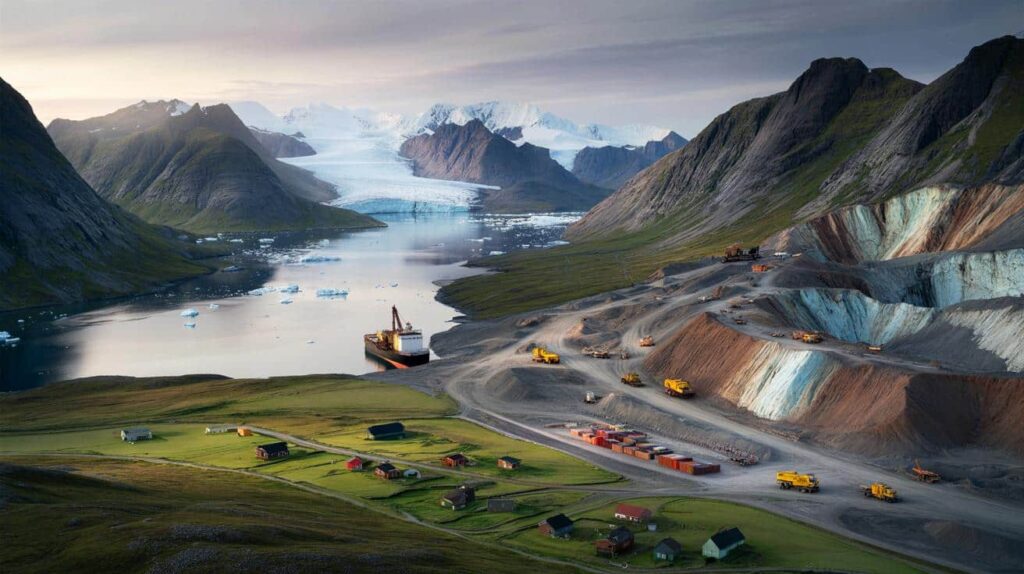
Why Greenland’s geology is so special
Greenland is the largest island on Earth and sits in a brutally strategic spot between North America and Russia. That alone would draw attention in a time of strained geopolitics. What really changes the game lies underground.

Its crust is packed with almost everything a 21st‑century economy runs on: oil and gas, iron, copper, zinc, silver, lithium, uranium and a cocktail of “rare earth” metals vital for electronics and low‑carbon technologies.

Greenland contains ancient rocks and metal‑rich formations found together at a scale rarely matched anywhere else on Earth.

Geoscientists point to a simple reason. Parts of Greenland are built from some of the oldest rocks on the planet. These rocks have been repeatedly crumpled, cracked and reheated by a long series of geological events:
- mountain‑building collisions that squeezed and fractured the crust
- rifting, when the crust stretched and began to tear apart
- volcanic activity linked to the opening of the North Atlantic
Each of these stages left something behind. When mountains rose, pressure and hot fluids pushed metals into cracks, forming veins of gold, rubies and graphite. During rifting, magma brought up other elements from deep in the mantle. When the Atlantic Ocean started to open in the early Jurassic, over 200 million years ago, it created new pathways for mineral‑rich fluids to circulate and cool.
Over geological time, that natural “processing plant” concentrated metals in ways that are convenient for mining and uncomfortable for climate politics.
The island that has almost everything we want
Modern societies rely on a wide mix of metals, and Greenland’s rock record ticks many of the boxes. According to estimates by the US Geological Survey, just the north‑east of Greenland could hold around 31 billion barrels of oil – roughly comparable to known reserves in the United States. That figure does not even count what may still lie under the central ice sheet.
Beyond fossil fuels, Greenland’s real strategic weight is tied to what powers clean‑tech ambitions. Rare earth elements used in wind turbines, electric car motors and smartphone components have been identified in large quantities, with some studies pointing to more than a million tonnes in potential reserves.
Oil, gas, lithium, rare earths, uranium: Greenland’s bedrock offers both yesterday’s energy and tomorrow’s technologies in one place.
Many of these metals are currently dominated by a handful of producers, particularly China. That makes Western politicians and defence planners look at Greenland differently. The island is not just remote ice; it is a possible route to reduce dependence on rival suppliers for strategically sensitive materials.
A quick look at key Greenland resources
| Resource | Main uses | Why Greenland matters |
|---|---|---|
| Oil and gas | Energy, chemicals, plastics | Large estimated offshore reserves in the Arctic seas |
| Rare earth elements | Magnets, electronics, missiles, wind turbines | Significant potential deposits outside Chinese control |
| Lithium & graphite | Batteries for EVs and grid storage | Graphite and lithium‑bearing rocks linked to ancient tectonic events |
| Uranium | Nuclear fuel | Politically sensitive, with strong local opposition in some areas |
Greenland’s ancient rocks, modern consequences
The age of Greenland’s crust is not just a curiosity for geologists. Very old rocks, known as cratons, tend to be chemically depleted in some elements and enriched in others. In Greenland, repeated cycles of compression and extension reworked those old foundations.
During mountain building, hot fluids moved through fractures, dropping out metals as they cooled. That process produced deposits of gold and gemstones, including rubies, as well as graphite – a key ingredient in lithium‑ion batteries used in phones, laptops and electric cars.
Later rifting episodes played a different role. As the crust stretched and thinned, magma rose, carrying rare metals from deep inside the planet. When the Atlantic began to open during the Jurassic, new volcanic and hydrothermal systems formed, concentrating elements like niobium, tantalum, and a suite of rare earths.
Greenland’s mineral wealth is a record of Earth’s violence: collisions, tears and eruptions frozen into its rocks.
Hydrothermal systems – where hot waters rich in dissolved chemicals circulate through rock – were particularly important. In southern Greenland, past volcanic activity fueled such systems, forming deposits of niobium, tantalum, ytterbium, dysprosium and neodymium. These names sound obscure, but they sit inside jet engines, fighter aircraft, offshore wind farms and high‑end audio speakers.
Warming climate, rising temptation
For decades, most of these resources remained largely untouched. The technical challenge of working beneath or near an ice sheet, punishing weather and isolation kept activity limited to small‑scale exploration and a handful of mines.
That equation is changing. As global temperatures rise, Greenland’s ice is retreating. Summers are longer and warmer. More rock is exposed. Sea ice that once locked in coastal waters for much of the year thins and clears earlier, opening shipping routes.
From the perspective of mining and oil companies, that makes logistics simpler and extraction cheaper. Heavy machinery can reach previously frozen sites. Ports can operate for more of the year. Satellite mapping and drones can scan bare rock that used to sit under snow and ice.
Climate change turns Greenland’s geological riches from a theoretical prize into a practical target.
The same warming that threatens to raise sea levels by several metres if Greenland’s ice sheet melts also makes tapping its mineral wealth easier. That contradiction sits at the heart of the island’s dilemma: the materials needed for a low‑carbon transition are locked inside a landscape destabilised by high‑carbon emissions.
The south: green fields, toxic memories
The tension feels particularly sharp in southern Greenland. In this region, steep mountains meet deep fjords, and crucially, many slopes are ice‑free through the summer. From June to September, grass covers the valleys. Local communities raise sheep and experiment with crops that were impossible a century ago.
This is one of the few areas where Greenland feels less like the Arctic and more like a subarctic farming region. Yet beneath those fields and pastures lie veins of lead, zinc, uranium and rare earths.
Earlier mining activity has left scars. Past operations contaminated soil and water with heavy metals and radioactive waste. Residents living near abandoned sites still worry about legacy pollution and how it may affect grazing land, fishing grounds and health.
When companies survey new deposits close to farms and villages, suspicion grows. People who depend on clean land and water fear a repeat of that history, only on a larger scale and in a more fragile climate.
Global powers, local voices
All this plays out against a backdrop of intense geopolitical interest. The United States, the European Union and China have each signalled different levels of intent in Greenland, from investment offers to research missions and mining partnerships.
The island is part of the Kingdom of Denmark, but has its own government and broad autonomy. Greenlandic leaders face pressure from all sides: promises of jobs and income, warnings about strategic vulnerability, and strong local concerns about environmental damage and cultural disruption.
For Greenlanders, the question is not just how much to mine, but who decides and who carries the long‑term risk.
Many people on the island see resource development as one of the few realistic routes to more economic independence. Others argue that chasing short‑term mining booms could lock Greenland into a pattern of extraction and cleanup familiar from other parts of the Arctic.
Key terms and future scenarios
Two concepts shape the debate and are worth unpacking. The first is “rare earth elements”. Despite the name, these metals are not exceptionally scarce in Earth’s crust. They are “rare” because minable concentrations are unusual and because refining them without heavy pollution is technically tricky. That makes new potential sources, like Greenland, deeply attractive but also controversial.
The second term is “hydrothermal deposits”. These form when hot, mineral‑loaded fluids circulate through cracks in the rock, cool, and leave behind metals. In Greenland, such systems created pockets rich in high‑tech metals. Any attempt to extract them at scale means breaking open those rocks and managing vast volumes of waste rock and chemically treated water in harsh, changing weather.
Looking ahead a few decades, several scenarios compete. One sees large open‑pit mines on currently icy plateaus, supported by new ports and airstrips, feeding global supply chains for electric vehicles and wind turbines. Another keeps extraction restricted and focuses instead on scientific research, tourism, fisheries and small‑scale agriculture, betting that untouched landscapes will hold their value as the Arctic warms.
There is also a middle path: tightly regulated, limited mining with strong environmental safeguards, heavy involvement of Greenlandic communities and long‑term funds for cleanup and diversification. That path demands strong governance and constant political stamina in the face of foreign pressure and fluctuating commodity prices.
In each case, Greenland’s geological uniqueness stays at the centre. The same ancient rocks that recorded a billion years of earthquakes, eruptions and drifting continents now sit in the crosshairs of climate models, defence planners and mining executives. What happens next will say a lot about how far the planet is willing to go to feed its hunger for new metals in a warming age.
