
On a gray Tuesday morning in Lyon, Thomas walked into a Red Cross donation center with a plastic bag of clothes and a guilty little secret. Nestled in the sole of his old Nike sneakers was an Apple AirTag, taped just under the insole. He’d spent years donating clothes, gadgets, even furniture, always wondering vaguely where they ended up. This time, he decided to actually find out.
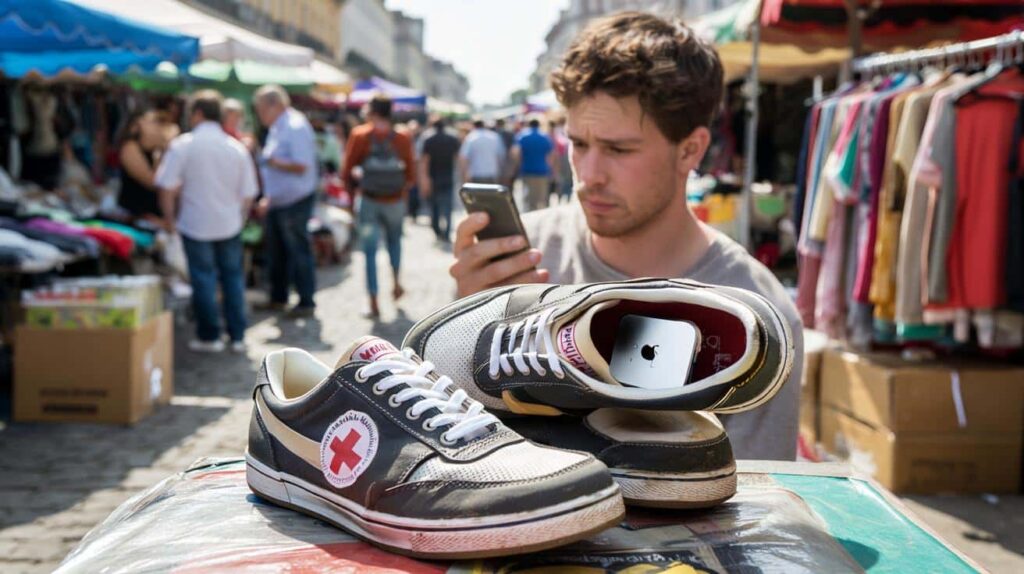
He dropped the bag on the metal table, signed nothing, and left with a polite nod. Two hours later, his phone buzzed: “Your AirTag was seen near Rue Garibaldi.”

That was only the beginning of the story.

When charity takes a surprising detour
Thomas thought his sneakers would end up on someone’s feet, somewhere in the city, maybe in a shelter or through a social program. A small gesture, like millions of others every year. Instead, his AirTag’s map started drawing a route that looked suspiciously like a delivery run. First a warehouse zone. Then a residential neighborhood. Then a busy market area known more for stalls than for social outreach.

He kept refreshing the screen on the bus home, half amused, half uneasy. What game was he playing, really?
By the end of the day, the AirTag had settled in a cluster of blue dots around a weekend flea market in a neighboring town. Curious and slightly nervous, Thomas went there on Saturday. Among piles of second-hand jeans and boxes of mismatched chargers, he spotted something instantly familiar: his beaten-up Nikes, laces re-threaded, soles wiped, price tag hanging.
They were on sale for 25 euros. A Red Cross sticker still half-torn inside the tongue. The seller shrugged when he asked where they came from. “From a lot,” he said. “Wholesale donations. Perfectly legal.”
On the way home, Thomas felt more puzzled than outraged. He’d always imagined his donations slipping directly into the hands of people in need, not into the circuits of resale and sorting. Reality was… messier. Less romantic. More logistical.
In truth, many big charities rely on resale to finance their programs: clothes sorted, the best sold, the rest exported or recycled. The sneakers on that market stall were part of an economy that most donors never see, half transparent, half opaque.
And suddenly, thanks to a tiny white disc hidden in a shoe sole, someone was watching that invisible route in real time.
What really happens to donated clothes (and how to donate smarter)
If you’ve ever stood in front of an overflowing wardrobe with a trash bag in one hand and a charitable glow in your chest, you know the gesture. You drop everything off, your conscience feels lighter, and the story stops there. For you. For your stuff, it’s just the beginning.
Donated clothes often pass through huge sorting centers where they’re graded by quality. The best go to charity shops. Others go to low-cost resale markets, sometimes abroad. Only a small share ends up directly and freely given to people in emergency need.
The problem isn’t that charities are “tricking” anyone. Reselling clothes can be one of the main ways they fund food aid, housing support, and crisis response. What no one really explains is that your T-shirt is just as likely to become a revenue tool as a garment for someone who’s cold.
So yes, that hoodie you gave with a lump in your throat might be crossing a border in a shipping container, headed for a second-hand market in another country. Or being sold at a local flea market by an intermediary who bought it by the kilo from a sorting center. It’s an entire hidden supply chain on the back of your spring cleaning.
Does this mean you should stop donating? Not at all. *It means you should donate with your eyes open.*
Ask yourself: do you want to support a social project financially through your belongings, or do you want them to land, free and direct, in someone’s hands? Both options are valid, just not identical.
 Michael Schumacher, the new separation
**The plain truth is: most of us dump bags of clothes and walk away without asking a single question.** Charities aren’t always crystal clear either, between communication about “helping families” and the very real need to keep their operations funded. The AirTag in Thomas’s sneakers simply tore the curtain down on a system that was already there.
How to keep your generosity… and your lucidity
If you want your donations to match your intentions, the first step is incredibly simple: ask. That’s it. Next time you go to a Red Cross shop, a secular charity, a church basement, just say: “What happens to these clothes?” Some volunteers will answer straightforwardly, others might be vague, but you’ll feel the difference instantly.
You can also split your gestures. Give your best pieces to a local association you know personally, one that redistributes directly. Send the big volumes and “medium” stuff to larger organizations who can monetize them to fund field programs.
We’ve all been there, that moment when you stuff everything into a bag 10 minutes before the donation center closes. No sorting, no thinking, just the urge to clear the chair buried under shirts. Let’s be honest: nobody really does this every single day.
Still, taking 15 extra minutes once in a while changes everything. Put aside the perfect-condition items: they’ll have a real second life. Put the damaged, pilled, or stained ones in another pile: some centers recycle textiles, others don’t. When you ask, “Do you recycle or do these end up in the trash?”, you’re not being annoying. You’re being responsible.
Sometimes, the discomfort we feel when discovering a resale stall full of “charity clothes” is just the shock of realizing how big and complex the chain is.
“People think their T-shirt goes straight from their hands to someone else’s,” says a volunteer from a Parisian sorting center. “The reality is that we’re running logistics, not magic. Selling part of what we receive is what keeps the lights on and the trucks running.”
To navigate this without becoming cynical, you can keep a small checklist in mind:
- Ask how the organization uses clothing donations: direct aid, shops, export, recycling.
- Prioritize local associations for items you’re emotionally attached to.
- Donate only clean, wearable clothes: trash is a cost, not a gift.
- Separate high-value items and consider selling them yourself, then giving the money.
- Accept that resale isn’t betrayal: it can be a funding tool for real, concrete help.
The invisible journey of our “good deeds”
Thomas didn’t buy back his own sneakers at the market. He watched a teenager try them on, bounce twice on his heels, then haggle them down to 20 euros. Somewhere between the donation bin and that stall, his shoes had changed status three times: gift, commodity, then prize purchase.
On the way home, he turned off the AirTag tracking and peeled it out of the sole. The experience had done its job. It had shown him that generosity, once released into the world, doesn’t follow a straight, pure line. It zigzags through warehouses, invoices, trucks, and stalls before touching someone’s life.
Maybe that’s the real lesson behind this little tech experiment. Our donations are part of an ecosystem that mixes solidarity and business, idealism and logistics. We can denounce it, ignore it, or try to understand it.
**What we give doesn’t just say something about us; it enters into systems that we rarely take the time to look at.** The AirTag incident is almost a metaphor: if we could track every object we let go of — clothes, furniture, money, data — what would we discover? Would we be shocked, reassured, or simply more adult in the way we choose to “do good”?
There’s no single right answer. Some will keep putting bags into anonymous bins and feel fine with that. Others will prefer smaller, face-to-face circuits where they can see who benefits. Some might even start selling their own clothes and donating the cash to specific projects.
The only real shift is this: instead of imagining a fairy-tale path for our old sneakers and sweaters, we can accept the messy, imperfect reality of modern solidarity. And decide, consciously, where we want to stand in it — AirTag or not.
| Key point | Detail | Value for the reader |
|---|---|---|
| Donations often get resold | Clothes can pass through sorting centers, then charity shops or markets | Adjust expectations and avoid feeling “betrayed” when discovering resale |
| Ask charities clear questions | “Do you resell, export, or redistribute directly?” | Align your donations with your real intentions and values |
| Sort your items before donating | Separate quality clothes, damaged items, and potential resale pieces | Increase the impact of what you give and reduce waste for organizations |
FAQ:
- Do charities have the right to sell donated clothes?
Yes. Most large organizations clearly state in their internal policies that part of the donations can be resold to finance their activities. The legal issue appears only if communication is misleading or if funds aren’t used for their stated mission.- Is my donation “less useful” if my clothes end up being sold?
Not necessarily. The resale can generate money that pays for housing support, food, medical care, or emergency programs. Your gift shifts from a direct material help to a financial contribution.- How can I be sure my clothes go directly to people in need?
Look for local associations that run clothing banks, shelters, or outreach programs and say clearly that items are redistributed for free. Small, community-based groups or church/mosque/temple charities often work this way.- What should I avoid donating?
Dirty, torn, moldy, or heavily stained items. Also underwear and socks in poor condition. These become a disposal cost for organizations and rarely help anyone. Ask if they have textile recycling before dropping borderline items.- Is it ethical to track donations with an AirTag?
Technically you’re tracking the object, not a person, but it opens privacy questions and can stress volunteers or workers if discovered. Using an AirTag once to understand the system can be eye-opening, yet relying on transparency and conversation is usually a healthier long-term approach.
