
The first thing you notice is the silence.
You step into the frosty garden, mug in hand, breath hanging in the air, and the world feels oddly still. No flashing red chest on the fence post. No bright eyes watching from the apple tree. The robin that usually appears the second you open the back door is nowhere to be seen.
Then you remember the news alert you scrolled past on your phone: the RSPCA is urging people to help garden birds, especially robins, as natural food runs low. You glance at your kitchen window. The fridge hums. Bread on the counter. A pot of oats in the cupboard.

The garden stays quiet.
You realise you’re not just missing a bird. You’re missing a tiny heartbeat in your day.
The quiet crisis happening right under our noses
Across the UK, robins that usually dart confidently across lawns are suddenly having a much harder time finding food. Cold snaps, drenched lawns and stripped hedgerows leave insects buried deep or gone altogether. For a bird that needs to eat almost constantly to survive, a few days of bad weather can turn into a real fight.

The RSPCA has been warning that small garden birds are at particular risk when temperatures drop or the ground freezes. Robins might look plump and sturdy with their round bellies and fierce little stares, but they burn through energy fast. And when the bugs and worms disappear, they turn to us.
One volunteer from an RSPCA wildlife centre in England described a typical winter morning. She opened the doors to find yet another underweight robin brought in by a worried member of the public, found fluffed up and barely moving under a hedge. The pattern is always the same: freezing nights, soaked soil, no accessible insects.
She said that on some weeks they see a steady trickle of these tiny birds, all in the same fragile condition: dehydrated, light as air, and desperately hungry. Many were found in ordinary suburban gardens. Places where a single plate of food could have made the difference between life and death.
The logic is brutally simple. A wild robin needs to eat around a third of its body weight in food every single day just to stay alive. That’s a lot when you weigh about the same as a couple of pound coins. When natural food runs out, every hour without calories starts to matter.
That is why welfare groups are speaking so clearly at this moment. They understand that if enough people provide the right kind of help from their own kitchen they can fill that gap. One small action from each garden multiplied across streets and towns quickly becomes a lifeline.
The humble kitchen staple your robin is quietly waiting for
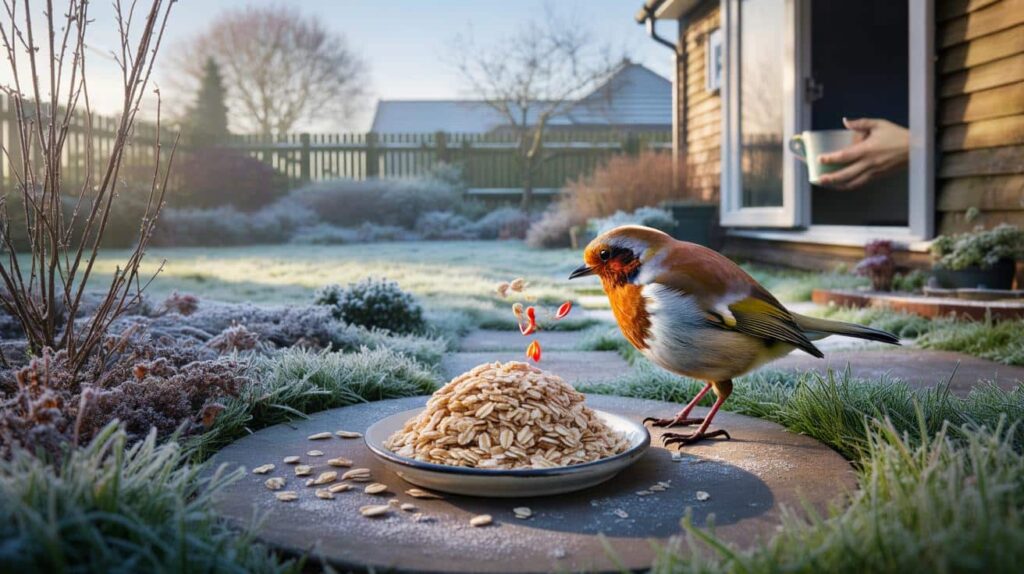
The RSPCA’s message is surprisingly simple: if you have robins in your garden, put out a small dish of plain porridge oats. Not cooked, not drowned in milk, just dry oats straight from the packet. They’re light, high in energy, and easy for robins to pick up and swallow.
➡️ With this €2.85 billion move, France gains a foothold in South Korea in a market set to soar: ultra‑pure gases
➡️ Spain turns engineering headache into new water power source without turbines
# Pellets: the little-known trick to save big on your heating before autumn
As temperatures start to drop and autumn approaches many households begin thinking about their heating costs for the coming winter months. One solution that deserves more attention is using wood pellets as a heating fuel. This option can help you reduce your energy bills significantly while keeping your home warm and comfortable. Wood pellets are small cylindrical pieces of compressed sawdust and wood waste. They measure about the size of a pencil eraser & provide an efficient and environmentally friendly way to heat your home. Many people overlook this heating method because they are not familiar with how it works or what benefits it offers. The main advantage of pellet heating is the cost savings. Pellets typically cost less than oil or propane and often compete favorably with natural gas prices. The exact savings depend on your location and current energy prices but many homeowners report cutting their heating bills by thirty to fifty percent after switching to pellets. Pellet stoves and boilers have become much more advanced in recent years. Modern units feature automatic ignition and temperature controls that make them as convenient as traditional heating systems. You simply fill the hopper with pellets & the system feeds them into the burn chamber as needed. Some models only require refilling once a day or even less frequently. Another benefit is the environmental impact. Wood pellets are made from renewable resources and produce fewer emissions than fossil fuels. The manufacturing process uses wood waste that would otherwise end up in landfills. When pellets burn they release roughly the same amount of carbon dioxide that the trees absorbed during their growth making them nearly carbon neutral. Before autumn arrives it makes sense to explore whether pellet heating could work for your home. The initial investment in a pellet stove or boiler can be substantial but various tax credits and rebates may be available to offset the cost. Over time the fuel savings usually pay for the equipment. If you decide to try pellet heating you should buy your fuel supply before winter when demand increases. Purchasing pellets in bulk during summer or early fall often results in better prices. You will need dry storage space since pellets must stay moisture free to burn properly. Installation requires proper venting and adequate space for the unit & fuel storage. Professional installation ensures safety & optimal performance. Once installed pellet heating systems need regular maintenance including cleaning the burn pot and ash removal but these tasks are straightforward. The comfort level from pellet heat compares well to other heating methods. Pellet stoves provide radiant warmth that many people find pleasant. Pellet boilers can integrate with existing radiator or radiant floor systems to heat your entire home evenly. For those concerned about power outages some pellet stoves can operate without electricity though most modern units require power for the auger and fans. Battery backup systems are available for areas with unreliable electrical service. The pellet industry has grown steadily as more consumers discover this heating option. This growth has improved availability & kept prices competitive. Most regions now have multiple suppliers making it easier to find quality pellets at reasonable prices. Switching to pellet heating before autumn gives you time to learn how your system works & make any necessary adjustments before the coldest weather arrives. You can experiment with temperature settings and feeding rates to find what works best for your home & lifestyle. The decision to use pellet heating depends on your specific situation including your home size, existing heating infrastructure & local fuel prices. However for many households this option provides substantial savings and a more sustainable way to stay warm during winter months.
➡️ Putting a dry towel into the dryer with your wet clothes can significantly reduce the cycle time and save on energy costs
➡️ Place your jade plant in this exact spot: the simple Feng Shui positioning trick said to boost wealth, harmony and lasting happiness at home
# Nivea: A Dermatologist Reviews the Blue Cream Formula
I decided to take a close look at the famous Nivea blue cream formula. As a dermatologist I wanted to share what I really think about this product that has been around for generations. The blue cream has a simple ingredient list compared to many modern moisturizers. The base contains mineral oil & petrolatum which create a protective barrier on your skin. These ingredients prevent water loss and keep moisture locked in throughout the day. Lanolin is another key component in the formula. This natural substance comes from sheep’s wool & works as an emollient. It helps soften the skin & adds to the overall moisturizing effect of the cream. The formula also includes glycerin which attracts water to the skin surface. This humectant property makes the cream effective at hydration. Many people notice their skin feels smoother after regular use. One thing to consider is the texture. The cream feels quite thick and rich when you apply it. Some users love this heavy consistency while others find it too greasy for daily wear under makeup. The fragrance is distinctive & nostalgic for many people. However those with sensitive skin might react to the added perfume. If you have fragrance sensitivities you should test the product on a small area first. For body use this cream works well on dry patches like elbows & knees. The occlusive ingredients make it particularly good for very dry skin during winter months. The price point makes it accessible to most people. You get a decent amount of product for relatively little money compared to luxury skincare brands. My honest assessment is that this cream does what it promises. It moisturizes and protects dry skin effectively. The formula is not revolutionary but it remains reliable and affordable for basic skincare needs.

➡️ The hidden cost of financial procrastination most people overlook
➡️ I followed the 50/30/20 rule for six months, here’s what really happened
You don’t need fancy feeders or a special budget for wildlife food. A shallow dish, a flowerpot saucer, or even a small upturned jar lid on the patio can do the job. Place it somewhere open enough that the robin can spot danger, but close enough to shrubs or a fence so it has a quick escape route. Then step back. Often, they find it faster than you expect.
People who have tried this once rarely stop. One reader from Kent told us she set out a teaspoon of oats “just to see” after reading a similar appeal. By the next morning, her robin had not only found the dish but was waiting on the fence each time she opened the back door. A routine was born.
Her children now call it “the breakfast date”. They put out oats before school, watch the robin swoop down, and snap quick photos through the glass. The bird that used to be a distant flash of red is now a familiar character with habits, favourite perches, even moods.
There’s a clear reason porridge oats work so well. They’re rich in carbohydrates and give robins a quick burst of warmth-protecting energy, without the salt and additives that can be harmful. Unlike large, tough grains, oats are small enough for that slender robin bill, especially when the ground is too hard to probe for worms.
Let’s be honest: nobody really does this every single day perfectly. Some mornings you’ll forget, rush out the door, or the cat will knock the dish over. That’s fine. The point isn’t perfection. It’s turning the idea of “I like seeing robins” into “I’m actually helping this robin survive the week.”
How to feed robins safely (and what to stop doing today)
If you’re going to help, do it right. The RSPCA’s ideal setup is wonderfully low-tech. Put a spoonful or two of plain porridge oats in a shallow dish or directly on a flat stone, at ground level or just above. Top up once a day rather than heaping on a mountain of food that will spoil or attract rats.
Try to keep the feeding spot roughly in the same place so the robin knows where to check. Early morning and late afternoon are prime feeding times, when they’re building and restoring energy. If you have a bird table, you can use that too, but leave a little space just for the robin, away from the chaos of larger birds like pigeons.
Where most people stumble is not out of cruelty, but out of habit. We’ve all been there, that moment when you absent-mindedly scatter leftover bread because that’s what you saw your grandparents do. The problem is that bread is basically junk food for robins: it fills them up quickly without giving them what they need to withstand the cold.
The RSPCA also warns against salty or seasoned foods, like bacon scraps, crisps, or anything cooked in oil. Milk can upset birds’ digestion too. If you want to go beyond oats, you can rotate in a few safe extras: grated mild cheese, chopped unsalted peanuts, or specially formulated insect-rich bird food from the supermarket.
“I always tell people: your garden might be one of a robin’s only reliable canteens in winter,” says an RSPCA wildlife officer. “A handful of the right food can carry them through the toughest week of the year.”
- Use: plain, uncooked porridge oats in small daily amounts.
- Avoid: salty, sugary, or seasoned leftovers like crisps, bacon, or gravy-soaked scraps.
- Position: shallow dish on a clear spot with nearby cover, away from prowling cats.
- Rotate: oats with grated cheese, sunflower hearts, or quality bird mix for variety.
- Observe: fluffed-up, lethargic, or ground-hugging robins may be struggling and need consistent food.
From “just a bird” to a shared winter story
Once you start feeding a robin regularly, the relationship changes. You stop seeing a generic bird and start noticing a particular individual, with its own way of tilting its head or guarding a favourite patch of fence. Children begin giving them names. Adults quietly time their tea breaks to the robin’s visits. The cold months feel slightly less bleak.
*Something microscopic shifts when you realise that this tiny life is, quite literally, counting on your kitchen cupboard.* You start checking the oat supply as routinely as you check the milk. You look out at the frost and don’t just see weather; you see a map of difficulty for all the small creatures trying to push through it.
This is the quiet power of the RSPCA’s appeal. It’s not asking for a grand gesture or a donation drive, but a routine kindness, repeated by thousands of people who will never meet. A spoon of oats on a saucer, in a hundred thousand gardens, every morning. A million fast heartbeats, just a little safer tonight.
| Key point | Detail | Value for the reader |
|---|---|---|
| Use porridge oats | Plain, uncooked oats offer safe, high-energy food when insects are scarce | Easy, cheap way to help garden robins survive harsh weather |
| Feed in small, regular amounts | Daily top-ups in a fixed spot help robins build a reliable routine | Creates close, repeat encounters and reduces food waste and pests |
| Avoid harmful leftovers | Bread, salty scraps, and dairy can be filling but nutritionally poor or unsafe | Prevents well-meant feeding from accidentally harming wildlife |
FAQ:
- Can I give robins cooked porridge instead of dry oats?It’s better to stick to dry, uncooked oats. Cooked porridge is sticky, can clog beaks and feathers, and often contains milk or sugar, which aren’t ideal for birds.
- Is bread really that bad for robins?Small amounts won’t instantly kill a bird, but bread is low in nutrients. It fills robins up without giving them enough energy or vitamins, which is risky in cold weather when every calorie counts.
- How close to the house should I put the food?You can place it quite close, even just outside a window or patio door, as long as there’s cover nearby. Many robins are bold and will happily feed within a few metres of people.
- What if other birds eat all the oats first?You can put out several small piles rather than one big heap, or offer some food on a lower, more sheltered spot that robins prefer while larger birds stay on the main feeder.
- How long should I keep feeding robins?You can help all year, but it’s especially useful from late autumn through early spring, and during cold snaps or heavy rain when natural food is hardest to find.
