
The first flakes started falling before dawn, thick and slow, swirling in the glow of a lonely gas station sign. By 7 a.m., the parking lot was already a lumpy sheet of white, tire tracks filling in almost as soon as they appeared. Drivers climbed out of their cars with stiff shoulders, phones in hand, refreshing radar maps and emergency alerts as if they might will the storm away. Inside, the clerk taped a fresh “No more ice melt” sign next to the coffee pots. People stared at it for a second longer than necessary, as though it were some kind of omen. Outside, the wind picked up, and the snow began to tilt sideways. Somewhere in the distance a plow rumbled to life, a lonely sound against a sky that looked like it wasn’t planning to stop. The winter storm warning had just turned real.
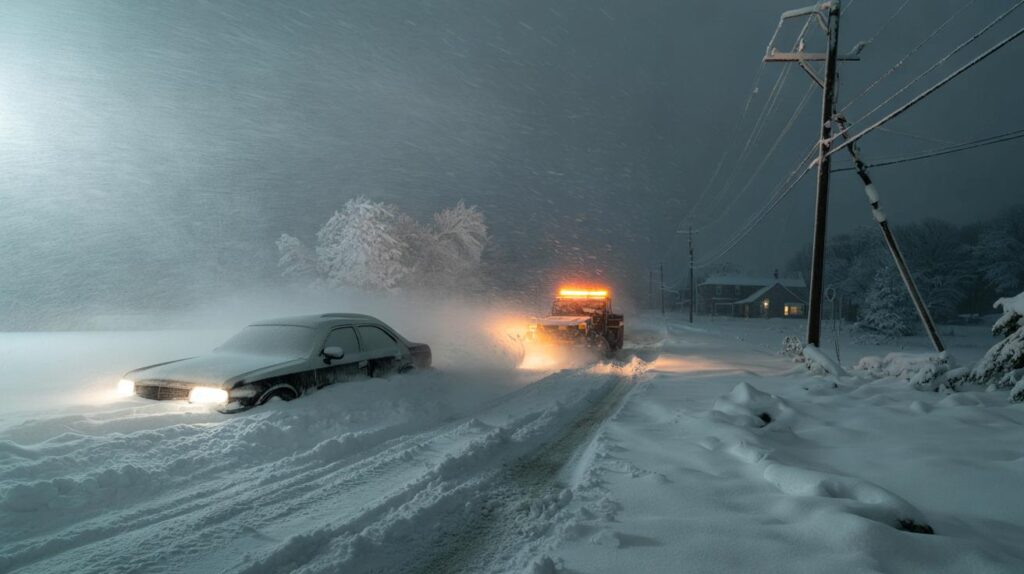
Up to 60 inches: when a storm crosses the line from big to brutal
On paper, “up to 60 inches of snow” sounds like a number you’d argue about on social media, not something that could bury your front door by Sunday night. Yet forecasters across several states are now circling that number, again and again, as an Arctic-fed system crawls in from the west. The National Weather Service winter storm warning covers a stretch of the country where people already know snow. This is different. This is the kind of storm that makes even seasoned plow drivers speak a little softer and gas station clerks say, “You stocked up yet?” with a raised eyebrow. When meteorologists start using words like “crippling,” you feel it in your stomach first, and only later in your driveway.

In the higher elevations, especially in mountain passes and ski towns, the forecast maps are almost surreal. Purples and deep blues stacked on top of each other, like an artist got carried away with the color fill tool. Some areas are staring down four to five feet of snow by Monday morning, with localized bands potentially topping that 60-inch mark. Down in the valleys and metro belts, the totals will be lower, but the impact may be worse: heavy, wet snow plastering trees and power lines, a quick changeover from freezing rain, roads turning to slush-rutted traps. One highway patrol captain, speaking quickly between calls, warned that even four-wheel drives will find themselves “outmatched and stuck” if they try to beat the storm.

The setup behind this is textbook and unnerving at the same time. A deep trough scoops cold air down from Canada while a charged-up Pacific system feeds it a conveyor belt of moisture. Those two ingredients meet over heavily populated corridors and rugged terrain, where lift and orographic effects squeeze every drop of water into snow. Because the storm is moving slowly, bands of intense snowfall will park over the same spot for hours, stacking inches that quietly turn into feet. That’s where the trouble starts: plows can’t keep up, visibility collapses, and small problems on the grid become cascading outages. It’s not just “a lot of snow.” It’s the timing, the temperature swings, and the sheer weight of what falls.
 Meteorologists warn early February signals suggest the Arctic is entering uncharted territory
Travel, power, and the quiet work of getting through a major winter hit
The first and simplest move, if you can manage it, is to cancel what can be canceled. That weekend road trip, the “quick drive” to see friends two towns over, the early-morning airport run you swore you’d power through. In storms like this, the safest travel is no travel. State transportation agencies are already warning that plows will focus on major routes and emergency access, not your backroad shortcut. Swap the mindset from “I’ll leave early and take it slow” to “I’ll stay home and not roll the dice.” For those who absolutely have to be on the road, the checklist gets serious fast: full tank, charged phone, blankets, water, non-perishable snacks, a shovel, and a tow strap in the trunk. That “just in case” kit stops feeling theoretical once you’re watching whiteout swallow the taillights ahead.
Power is the second domino everyone quietly worries about. Wet, heavy snow and gusty winds are a bad combination for aging infrastructure and tree-lined streets. Utility crews are already on standby, substations inspected, extra line workers moved into likely hit zones. At home, this is the time to do the unglamorous things: test flashlights, dig out batteries, bring the grill out from under the deck where it’s frozen in place. Charge the things that matter before the first band of real snow hits: phones, battery packs, headlamps, laptops if you need to work offline. Then there’s heat. People with wood stoves and generators suddenly become very popular with neighbors. Space heaters need clear space, carbon monoxide detectors need working batteries, and extension cords have to stop pretending to be permanent fixtures. Let’s be honest: nobody really does this every single day. But a 60-inch forecast has a way of sharpening priorities.
We have all experienced that moment when you check your pantry & discover your storm preparation consists mainly of coffee pasta & a can of beans with an uncertain expiration date. This weekend requires more thoughtful planning. You need short and simple meals that work on a single burner or a grill. If your medication is running low you should get extra supplies. Stock up on pet food and baby supplies and include comfort snacks because stress hits hardest at 3 a.m. when the house becomes silent and wind begins shaking the windows. One emergency manager I talked to expressed it directly:
“People think it’s about surviving the storm,” she said. “Most of the real strain hits during the three days after, when the roads are half-open, the power’s only back in some neighborhoods, and everyone’s exhausted.”
- Before the snow: Fuel up, charge devices, shop once with a clear list, move cars off the street.
- During peak hours: Stay off the roads, keep phones on low-power mode, check on neighbors by text or call.
- If the power goes out: Layer clothing, keep fridge closed, use generators outside only, share warm spaces when possible.
- After the storm: Shovel in short sessions, clear vents, watch for falling ice, resist the urge to “just go for a drive.”
- For mental sanity: Download shows and playlists, set small tasks, let the day be slow on purpose.
Living through a once-in-years snowfall and what we remember after
Storms like this tend to divide time into a before and an after. Before, it’s all forecast maps, group chats, hardware store lines, the low-level hum of anxiety behind normal life. After, it’s snowbanks taller than your car, sidewalks carved into narrow tunnels, and a strange calm when traffic finally thins to almost nothing. Kids remember the snow days, the epic forts, the way the sky felt closer and quieter. Adults remember the strain: the endless shoveling, the sore backs, the anxious scroll through outage maps at midnight. Somewhere in between sits a softer truth. These weekends reveal which neighbors knock on each other’s doors, who has a spare extension cord, which local diner stays open just long enough to hand out hot coffee to plow crews.
There’s also a subtle reset that happens when the world slows under that much snow. Meetings get postponed, flights canceled, plans reimagined. People pay attention to the weather not as background noise but as the main character. That can be scary, especially when the numbers climb as high as 60 inches and officials are blunt about “severe travel and power disruptions.” It can also be grounding. The storm doesn’t care about our schedules. It just moves through, flake by flake, drift by drift. *The choice is what kind of story we create inside our homes and communities while it does its work.*
➡️ Heavy snow expected starting tonight
➡️ Bad news for gardeners: a 135 fine may apply if you use collected rainwater without proper authorization starting February 31,

➡️ Heavy snow is expected to begin tonight as authorities urge drivers to stay home, even while businesses push to keep normal operations running
➡️ Too expensive even for China : the country halts its ambitious race with Europe to build the world’s largest particle accelerator
# Hairstyles after 60: forget old-fashioned looks – this haircut is considered the most youthful by professional hairstylists
Reaching your sixties does not mean you need to settle for outdated hairstyles that add years to your appearance. Professional hairstylists agree that certain haircuts can take years off your look while keeping maintenance simple and style fresh. The layered bob has emerged as the top choice among hair professionals for women over sixty. This versatile cut falls somewhere between chin & shoulder length and features multiple layers that create movement and volume. Unlike the severe bobs of decades past, this modern version softens facial features and draws attention away from fine lines. What makes this haircut so effective is its ability to work with natural hair texture rather than against it. The layers help thin hair appear fuller while giving thick hair a lighter and more manageable feel. The cut frames the face in a flattering way that highlights your best features without requiring hours of styling each morning. Stylists recommend keeping the length between the jawline and collarbone for the most flattering effect. This range allows enough hair to create shape while avoiding the weight that can drag down your overall appearance. Adding subtle highlights or lowlights can enhance the dimensional quality of the cut and bring warmth to your complexion. The beauty of this haircut lies in its low maintenance requirements. A quick blow-dry with a round brush creates polish for special occasions while air-drying produces a relaxed everyday look. The style grows out gracefully and typically needs trimming only every six to eight weeks. Many women over sixty worry that shorter hair might seem too drastic or unflattering. However the layered bob offers a middle ground that feels neither too young nor too matronly. It projects confidence & shows that you care about your appearance without trying too hard to look younger than your years. This haircut works particularly well for active lifestyles since it stays out of your face during exercise or outdoor activities. The style transitions easily from casual daytime wear to elegant evening events with minimal adjustment.
# Two American Teenagers Challenge 2,000 Years of Mathematical History with New Proof of Pythagoras’ Theorem
Two high school students from the United States have accomplished something that mathematicians long considered impossible. They developed a new proof of the Pythagorean theorem using trigonometry. For over two thousand years scholars believed that proving this famous mathematical principle through trigonometry could not be done. The main obstacle was circular reasoning. Trigonometric functions themselves rely on the Pythagorean theorem so using them to prove it would be like using an answer to prove itself. The teenagers found a way around this logical trap. Their approach uses trigonometric concepts without falling into the circular reasoning problem that stumped mathematicians for centuries. This achievement demonstrates that young minds can still make meaningful contributions to ancient fields of study. The mathematical community has taken notice of their work. Their proof adds to the small collection of valid demonstrations of this fundamental geometric principle. The Pythagorean theorem states that in a right triangle the square of the longest side equals the sum of the squares of the other two sides. This relationship has applications in construction, navigation computer graphics and countless other fields. What makes this discovery remarkable is not just the mathematical innovation but also the age of the discoverers. These students tackled a problem that professional mathematicians had set aside as unsolvable through this particular method. Their success reminds us that breakthrough thinking can come from unexpected places. Sometimes fresh perspectives unencumbered by years of conventional thinking can see solutions that others missed.
➡️ The United Kingdom is building a monster designed to twist plasma in every direction to bring fusion power closer
➡️ Psychology says people who clean as they cook, instead of leaving everything until the end, consistently share these 8 distinctive traits
Nobody gets a perfect version of this right. Somebody will forget to buy batteries. Someone else will brave the roads for a reason that, in hindsight, wasn’t worth it. The plain truth is that big winter storms are messy, tiring, and sometimes dangerous, but they also carry small, human moments that stick. A stranger pushing your car out of a snowbank. A neighbor clearing your steps without asking. A shared thermos of soup when the lights have been out for eight hours. As the warnings flash and the radar fills in, the forecast is already set. What’s still unwritten is how we look out for each other, what we’ll tell about this weekend years from now, and which details we’ll remember when the snow finally starts to melt.
| Key point | Detail | Value for the reader |
|---|---|---|
| Travel will be dangerous to impossible | Up to 60 inches in some areas, whiteout conditions, limited plow coverage | Helps decide when to stay home and cancel non-essential trips |
| High risk of power disruptions | Heavy, wet snow and strong winds threatening lines and transformers | Encourages early charging, heating plans, and backup options |
| Preparation can reduce stress | Simple supplies, realistic plans, neighbor check-ins | Turns a chaotic event into a more manageable, safer experience |
FAQ:
- Question 1What does a winter storm warning actually mean for my day-to-day plans?
- Question 2Is it safe to drive if I have snow tires and a four-wheel-drive vehicle?
- Question 3How long should I be prepared to be without power?
- Question 4What should go into a basic winter storm emergency kit at home?
- Question 5How do I safely help neighbors or family during and after the storm?
