
The boat’s engine cuts and, for a moment, the South China Sea falls strangely quiet. No gulls, no waves slapping the hull. Just a wide, flat circle of turquoise water that looks like any other patch of open ocean. Then the barge opens its belly and a torrent of sand roars into the sea, turning blue water milk-white in seconds.
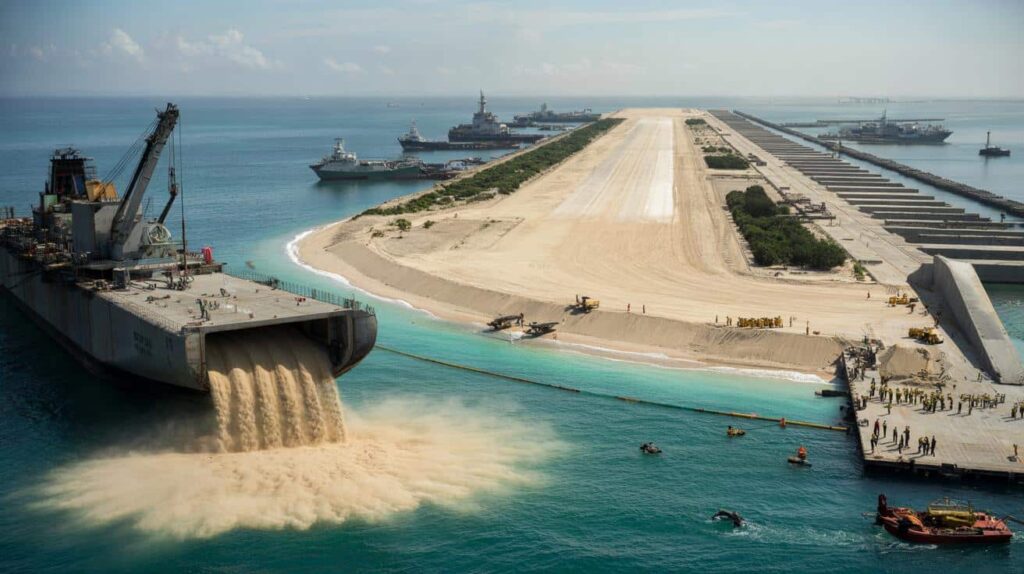
From a distance, it feels unreal, like watching land being downloaded into the world. Grain by grain, dump by dump, a new outline appears where, a decade ago, there was only deep water.

Cranes poke into the sky like metal bugs somewhere far off. Soldiers run on a newly built concrete dock. The real islands are starting to match what China pictured them to be.

The ocean is changing gradually with each ship that passes through it. Ships are transforming the sea bit by bit as they travel across the water. Every vessel that crosses the ocean contributes to altering its character over time. The sea undergoes continuous change through the steady movement of maritime traffic.
 Seniors Applaud New EU Directive Ensuring Lifetime Renewal of Driving Licences After Seventy
How China turned empty water into hard land
If you rewind the satellite images back to 2012, this corner of the South China Sea looks almost bare. A few lonely reefs, some submerged rocks, long fingers of turquoise shallows trailing under the waves. Ships skim past, but they don’t stop. There is nothing to stop for.
Fast forward just a few years, and those same pixels explode with grey and beige. Runways appear where corals once glowed. Harbors bite into what used to be open sea. The shapes are unmistakable: airstrips, helipads, radar domes, fuel tanks, rows of housing blocks.
It’s like watching a time-lapse of cities growing, except the “soil” is ocean and the seeds are sand.
Take Fiery Cross Reef. On paper, it used to be barely more than a ring of coral and rock, often washed over by waves at high tide. Fishermen knew it, not as a place to stay, but as a hazard to avoid.
Then came the dredgers. Massive ships with vacuum mouths scraped sand and sediment from the seabed, then pumped that slurry onto the reef. Day after day, month after month, they sprayed plumes of pale sand into the air, letting it settle, compact and rise above the tide line.
Today, Fiery Cross boasts a 3,000-meter runway, hangars, lighthouses, radar stations and anti-aircraft positions. What was once a barely-there reef is now a full-fledged island with a postal address and a military schedule.
➡️ Psychologists waving “thank you” at cars while crossing the street is strongly associated with specific
➡️ Known as the most fertile soil on Earth, the “black gold of agriculture” has chernozem layers up to 1 meter deep and turned Ukraine, Russia and Kazakhstan into one of the world’s biggest breadbaskets and strategic assets
Engineers confirmed plans to build an underwater rail line that would connect continents through a massive deep sea tunnel. This ambitious project raises an important question about whether it represents a bold step forward or a dangerous risk. The proposed tunnel would stretch across ocean floors to link landmasses that are currently separated by water. Transportation experts and construction specialists have been working on the technical details needed to make this concept a reality. The project would require advanced engineering methods & substantial financial investment. Supporters of the plan argue that an underwater rail connection could transform global travel & trade. The tunnel would allow people and goods to move between continents much faster than current shipping methods permit. This could strengthen economic ties between regions & create new opportunities for international cooperation. However critics have raised serious concerns about the feasibility and safety of such a massive undertaking. Building a tunnel at extreme ocean depths presents numerous technical challenges that have never been solved at this scale. The structure would need to withstand enormous water pressure & potential seismic activity. Maintenance and emergency response in such a remote location would also be extremely difficult. The financial costs of the project would likely reach hundreds of billions of dollars. Questions remain about whether any combination of governments or private investors would be willing to fund such an expensive and uncertain venture. The construction timeline would probably span decades and require international coordination on an unprecedented level. Environmental groups have also expressed worries about the potential impact on marine ecosystems. The construction process could disturb ocean floor habitats and affect migration patterns of sea life. Long term operation of the tunnel might create additional ecological challenges that are difficult to predict. Despite these obstacles the engineering teams behind the proposal remain confident that modern technology makes the project possible. They point to existing underwater tunnels like the Channel Tunnel between England & France as proof that submerged rail connections can work successfully. However those examples operate at much shallower depths & shorter distances than what this new project would require. The debate over this underwater rail tunnel reflects broader questions about human ambition and technological progress. Some view it as an inspiring example of what humanity can achieve through innovation and determination. Others see it as an example of overreach that ignores practical limitations and potential dangers. As discussions continue the project remains in early planning stages. No construction timeline has been set and many technical details still need to be resolved. Whether this underwater rail connection will ever become reality depends on resolving the complex engineering challenges and securing the massive resources required. They’ve
➡️ The subtle psychological sign that you’re craving emotional safety
➡️ Psychology explains that people who prefer being alone are often recharging their energy, not withdrawing from others
➡️ I saw how they sharpen knives in India, and now I do it myself at home, even old knives become razor sharp in just one minute.
➡️ Scientists observe a vast underwater fracture spreading along a tectonic boundary and it could reshape entire coastlines
# This Small Fridge Adjustment Keeps Vegetables Crisp Longer
Most people store their vegetables in the refrigerator without giving much thought to where exactly they place them. However the location of your produce inside your fridge can make a significant difference in how long it stays fresh and crisp. The crisper drawer exists for a reason. This special compartment at the bottom of most refrigerators is designed to maintain optimal humidity levels for fruits and vegetables. The drawer helps create a microclimate that differs from the rest of the fridge interior. Many modern refrigerators include humidity controls on their crisper drawers. These controls allow you to adjust the airflow into the drawer. When you slide the control to high humidity it restricts airflow and traps moisture inside. The low humidity setting increases airflow and allows moisture to escape. Leafy greens & vegetables that wilt easily need high humidity. This includes lettuce, spinach broccoli carrots & celery. These items lose moisture quickly and benefit from the humid environment that prevents them from drying out. Fruits & vegetables that tend to rot rather than wilt do better in low humidity. Apples, pears, stone fruits & peppers fall into this category. These items release ethylene gas as they ripen. Better airflow helps disperse this gas & prevents premature spoiling. Temperature also plays a crucial role in vegetable storage. The back of the refrigerator tends to be colder than the front because cold air circulates from the back. Delicate items should stay toward the front where temperatures remain more stable. The top shelves of your refrigerator maintain the most consistent temperature. The door experiences the most temperature fluctuation because it opens frequently. Avoid storing delicate produce in the door compartments. Some vegetables should not go in the refrigerator at all. Tomatoes lose their flavor and develop a mealy texture when refrigerated. Potatoes convert their starches to sugars in cold temperatures which affects their taste and cooking properties. Onions and garlic also prefer room temperature storage in a cool dry place. Before placing vegetables in the crisper drawer remove any tight plastic packaging. Plastic wrap can trap excess moisture against the produce and encourage mold growth. Instead use perforated plastic bags or simply leave items loose in the drawer. Washing vegetables before storage generally shortens their lifespan. The extra moisture promotes bacterial growth and speeds up decay. Wait to wash produce until right before you plan to use it. Keep ethylene-producing fruits away from ethylene-sensitive vegetables. Apples, bananas and tomatoes release high amounts of ethylene gas. This gas causes nearby produce to ripen and spoil faster. Store these items separately when possible. Check your crisper drawers regularly and remove any spoiled items immediately. One rotting vegetable can affect everything around it. A quick inspection once or twice a week helps you catch problems early. The simple act of adjusting your humidity controls & organizing your produce properly can extend freshness by several days or even weeks. This means less food waste and fewer trips to the grocery store. Your vegetables will maintain their crisp texture and nutritional value much longer with these straightforward changes to your refrigerator habits.
The basic recipe sounds simple: find a shallow reef or shoal, dredge sand from around it, and pile that sand until it sticks out of the water. Then reinforce it with concrete, seawalls and infrastructure. Beneath the simplicity sits a brutal logic.
Once you have hard land, you can claim a 12-nautical-mile territorial sea around it. You can dock ships, land jets, deploy missiles, fly your flag. Land is power, and in oceans disputed by several countries, **every extra meter of dry ground means leverage**.
China has spent about 12 years dumping hundreds of millions of tons of sand into disputed waters. This was not some strange engineering test. It was a strategy to transform unclear dotted lines on maps into actual land that people can walk on.
The method behind the man-made islands
Building islands from scratch starts, oddly enough, with maps and mud. Chinese planners first pore over nautical charts and satellite images, hunting for “good bones” under the water: reefs, banks and shoals that sit just below the surface. These act like buried foundations.
The dredgers show up next. These vessels drop long suction pipes down to the ocean floor and vacuum up sand & silt and crushed coral. The mixture gets pumped through floating hoses to the selected reef and then sprayed in wide arcs that might look pretty from far away. Almost pretty.
Engineers level the new land and use heavy machinery to compact it. They surround the area with rock & concrete to prevent waves from destroying it. Buildings start to appear from the edges only after the island becomes stable and stops sinking or shifting.
From a distance, the process can look strangely clean, like high-tech landscaping on a gigantic scale. Up close, it’s messy, noisy, and hard on the people involved. Workers live for months on floating dormitories, sleeping in cramped bunks that reek of diesel and damp clothes.
Storms can undo weeks of work overnight. A bad typhoon can slice off newly planted shores, dumping fresh sand back into the sea. Engineers fight that with thicker seawalls, deeper piles, heavier rock. Let’s be honest: nobody really does this every single day without stopping to wonder what will happen if the sea pushes back harder.
Still, the schedule never really sleeps. Dredgers work at night, their spotlights throwing ghostly cones over the water as the islands slowly swell, like something breathing.
Behind all this physical effort lies careful political choreography. Chinese officials publicly describe these projects as “improving living conditions” and “providing navigational safety”, pointing to lighthouses, search-and-rescue centers and weather stations.
At the same time, the islands have sprouted long runways, deep ports and hardened shelters that fit fighter jets and missile batteries. Other countries in the region — Vietnam, the Philippines, Malaysia — also build on disputed features, but on a smaller scale and with fewer airstrips and radars.
One maritime analyst explained it to me during a poor quality Zoom call:
“Sand is cheap. Concrete is cheap. What’s expensive is influence — and that’s exactly what these islands buy.”
# Understanding Trade-offs: A Simple Framework
To understand the trade-offs involved you should imagine a basic box structure. This mental model helps you see the different options available & what you gain or lose with each choice. When you visualize decisions this way it becomes easier to weigh competing priorities against each other. Think of the box as having four quadrants. Each section represents a different combination of factors you need to consider. By placing your options into these quadrants you can compare them directly & see which trade-offs make the most sense for your situation. The box framework works because it forces you to be explicit about what matters. Instead of juggling abstract concepts in your head you have a concrete visual reference. This makes it harder to ignore important factors or fool yourself about the real costs of a decision. When you face a complex choice start by identifying the two main dimensions that matter most. These become the axes of your box. Then plot your options based on where they fall along each dimension. The resulting picture shows you exactly what you are trading off. This approach is particularly useful when different stakeholders care about different things. The box lets everyone see the same information and understand why certain options involve difficult compromises. It turns subjective feelings into objective comparisons. You can apply this framework to almost any decision. Whether you are choosing between product features allocating resources or setting strategic priorities the basic principle remains the same. Make the trade-offs visible so you can evaluate them clearly. The key is keeping it simple. Do not try to cram too many variables into one box. Focus on the two or three factors that really drive the decision. Additional complexity might feel more sophisticated but it usually just makes the choice harder without improving the outcome.
- Sand and dredgers: fast way to turn water into land
- Coral and fish: first victims of that speed
- Runways and ports: new tools of presence and pressure
- Storms and erosion: silent tests that never really stop
What these islands really change for everyone else
For people far from the South China Sea, this might feel like a distant science project. Yet the ripple effects run through global shipping lanes, fish markets and even your phone’s supply chain. A third of the world’s maritime trade passes through these waters, including oil, gas and the components that keep factories from Tokyo to Berlin humming.
When one country builds fortified islands in the middle of that crossroads, every other nation that relies on those sea lanes starts watching more closely. Warships shadow each other. Surveillance planes trade warnings over crackling radios. A misread gesture at sea can spread online in minutes.
*Suddenly, a once-abstract reef has the power to nudge stock markets and rewrite diplomatic talking points in capitals you’ve actually visited.*
Coastal communities in Southeast Asia experience this change as something real rather than theoretical. It feels like a gradual squeeze on their way of life. Fishermen from the Philippines and Vietnam say they get forced out of fishing areas they have used for generations. These areas now surround newly built islands. The fishermen describe encounters with water cannons & laser devices designed to disorient them. They also report drones flying above and monitoring their movements.
Overfishing and climate stress were already shrinking their catch; fortified islands add patrol boats and new lines they’re told not to cross. That’s the quiet, human cost: a fisherman staring out at a horizon he’s known since childhood and realizing some of it is now off-limits.
We all experienced that moment when a place that once felt open suddenly has rules nobody agreed to. In this case the boundary in the water was created with sand and steel. The shift happens quietly at first. A location that seemed accessible to everyone becomes restricted. New barriers appear without warning or discussion. What was once shared space turns into controlled territory. This particular boundary was not marked with signs or fences. Instead it was built using physical materials in the water itself. Sand and steel formed the dividing line that separated one area from another. The change affects how people use the space. Activities that were normal before become questionable or forbidden. The freedom to move through an area gets replaced by limitations on where you can go. Nobody asked for permission before these rules took effect. There was no vote or community input. The restrictions simply appeared one day as an established fact. The materials chosen for this boundary tell their own story. Sand suggests something temporary that might shift with tides and currents. Steel indicates permanence and strength. Together they create a barrier that is both adaptable and unmovable. People who used this space before now face a different reality. They must navigate around the new restrictions or challenge them. The place that felt like it belonged to everyone now clearly belongs to someone with the power to set limits. This pattern repeats in many locations. Open areas become closed. Shared resources become private property. The transformation often happens gradually until one day the change is complete and undeniable. they’ve
There’s also the planet itself to think about. Marine biologists who have dived near the new islands describe plumes of sediment smothering coral, turning complex reefs into pale rubble. Those reefs aren’t just pretty underwater postcards. They’re nurseries for fish, natural storm barriers and carbon stores.
Some Chinese projects have tried to transplant corals or plant “artificial reefs” nearby, but nature doesn’t usually snap back on command. Erosion keeps nibbling at man-made shores, while rising sea levels quietly test whether all that sand can really stay above water for decades. **Engineering can cheat the ocean for a while, but the ocean always gets a rematch.**
The plain-truth sentence here is simple: you don’t move this much sand without leaving scars, and not all of them are visible from space.
A story still being written, tide by tide
Scroll over this part of the world on a satellite map today and the islands pop out like concrete punctuation marks in a blue paragraph. A few years ago, they were dots of reef that only mariners cared about. Now they’re characters in a bigger story about power, climate, and the lengths a country will go to anchor its ambitions in solid ground.
The strange thing is, the story has no clear ending yet. Some of these islands will likely harden into permanent bases, with families, shops, schools, maybe even tourists one day posing under fluttering flags. Others might slump and crack as storms get nastier and seas climb higher, leaving behind half-submerged ruins and rusted seawalls.
Other countries are watching and learning. Some might follow with their own dredgers; others will push for legal rules that say where the sand stops and the law begins. Tech companies feed fresh satellite images into their algorithms, tracking every new pier and radar dome in near real time.
For you and me, these distant specks of engineered land are a reminder of something bigger: coastlines aren’t as permanent as they look on paper. Borders can move not only with wars or treaties, but with pumps, pipes and stubbornness.
The next time you look at a map on your phone and see that calm blue expanse, you might wonder which parts of it will still be water in 20 years — and which will be runway, harbor, or a tiny town where the sand never quite forgets it used to be sea.
| Key point | Detail | Value for the reader |
|---|---|---|
| Sand can redraw maps | China has spent around 12 years turning reefs into fortified islands by dumping massive volumes of dredged sand. | Helps you grasp how physical geography — and political claims — can shift faster than most of us realize. |
| Islands change power at sea | Runways, ports and radars on new islands extend military reach and influence over key shipping lanes. | Shows why this isn’t just local news, but something that can affect global trade and security. |
| The ocean remembers | Dredging damages reefs, alters ecosystems and faces long-term tests from storms and sea-level rise. | Invites you to think about the long game: what happens when engineering meets a changing climate. |
FAQ:
- Question 1How many artificial islands has China built in the South China Sea?China has significantly expanded at least seven major reef features into large artificial islands, especially in the Spratly archipelago, and has upgraded or reinforced several others across the region.
- Question 2How does China physically create these islands?Engineers use giant dredging vessels to suck sand and sediment from the seabed and pump it onto shallow reefs, where the material is shaped, compacted and then protected with rock and concrete seawalls.
- Question 3Are these islands legal under international law?The UN Convention on the Law of the Sea doesn’t recognize new man-made structures as creating full new maritime zones, and a 2016 tribunal rejected some of China’s claims, but Beijing rejects that ruling and continues to act on its own interpretation.
- Question 4Do these islands really harm the environment?Yes, dredging buries coral reefs, muddies the water, disrupts fish habitats and can permanently alter local ecosystems, even if some restoration projects are attempted later.
- Question 5Could other countries start building similar islands?Some states already reclaim land on a smaller scale, but China’s pace and scale are unique; as technology spreads and seas rise, more governments may be tempted to copy at least parts of this playbook.
