
If we could summon a genie from a magic lamp and ask for just one wish, many of us would ask for the same thing: more hours in the day. Extra time to work on passion projects, care for ourselves, move closer to our goals, or simply catch our breath. Most days seem to disappear before we’ve done anything truly for ourselves. But what if the time we’re craving isn’t missing at all—what if it’s quietly hiding in our evenings?
Nutritionist, author, and podcast host Radhi Devulkia shared on her podcast that the average person spends about three hours each evening watching TV. Over a year, that adds up to roughly 45 days—without even counting phone scrolling. “Imagine if you used just half of that time on the things you always say you don’t have time for,” she said. “That’s more than 20 full days you’ve just given back to yourself.” That perspective was the wake-up call I needed. Instead of fighting my evenings, I decided to design a routine that worked with my energy. Below are five small habits inspired by Devulkia that helped me take my evenings back.

Reframe what evenings are for
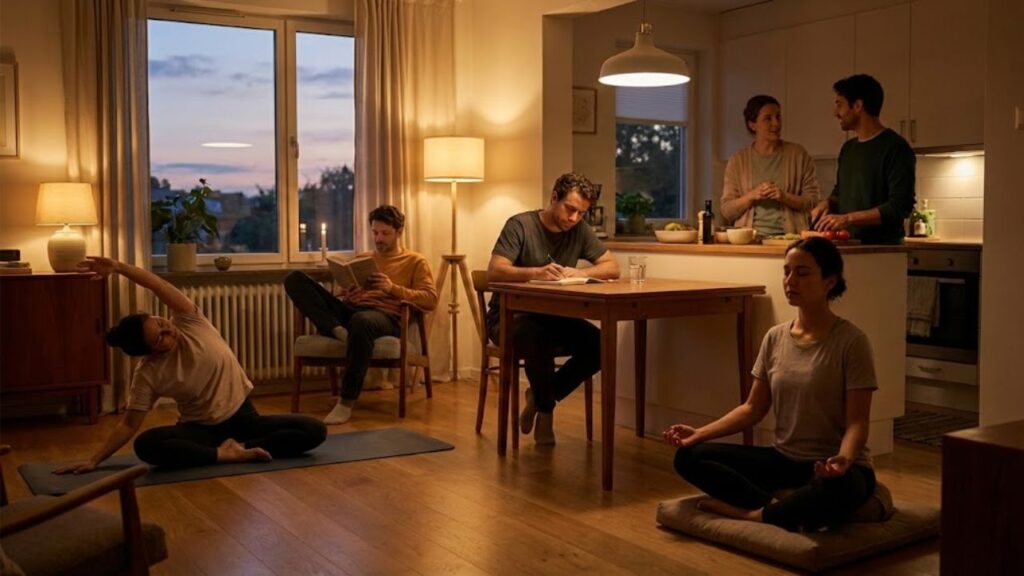
We’re used to thinking of evenings as time to completely switch off—hours on the couch, TV playing, phone in hand. Devulkia explains that we’ve trained ourselves to treat evenings as passive consumption rather than intentional rest. While occasional “doing nothing” has its place, doing it every single night rarely leaves us feeling restored.
 20 Small Daily Habits That Quietly Improve Inner Peace Emotional Balance and Long-Term Happiness
She suggests thinking of evenings as a time for active rest. This means tuning in to what kind of rest you actually need—physical, mental, or emotional—and choosing activities that support that. If your body feels tired, you might rest physically while engaging your mind by reading in a warm bath. If your mind is exhausted, light movement or a few minutes of quiet breathing may be more nourishing.

Once I started seeing my evenings this way, my binge-watching naturally decreased. That time slowly shifted toward things that move my life forwardtaking an online writing class, going to the gym, or cooking a healthy dinner.
Create a pre-commitment strategy
“Every goal needs a strategy Devulkia says, “so why would evenings be any different Without a plan, we default to habits that require the least effort. Her advice is simple: don’t leave your evening to chance.
One easy strategy is to write down your evening intentions earlier in the day. A quick list on a sticky note placed somewhere visible helps eliminate decision fatigue when you get home. You don’t have to think—you just follow the plan.
Devulkia also recommends preparing multiple options. Have a plan A, B, and C depending on your energy level. For example: if you’re mentally drained, go for a walk; if you’re physically exhausted, listen to a podcast while resting; if you’re emotionally overwhelmed, turn on Do Not Disturb and work quietly on something meaningful. Planning for your energy makes follow-through far more realistic.
Create friction for distractions
Habit experts often emphasize removing triggers from your environment, and Devulkia agrees. When distractions are always within reach, we’re making it harder for ourselves to succeed.
Instead, add a little friction between you and the habits you’re trying to reduce. If you want to spend more time creating art, leave your phone in another room while you paint. If you want to cook more at home, delete food delivery apps. If fitness is your goal, join a class or group where skipping requires extra effort.

Small barriers can be powerful—they give your better intentions a chance to win.
Bargain with yourself
Willpower isn’t consistent, and Devulkia doesn’t expect every evening to be perfectly productive. On nights when motivation is low, she suggests negotiating with yourself instead of giving up entirely.
The deal might be simple: commit to just 20 minutes of a goal-aligned activity, then allow yourself to do whatever you want afterward. Often, starting is the hardest part. “Once I begin,” Devulkia says, “I usually end up continuing longer than I planned.”
And even if you don’t? Twenty minutes still counts. Progress doesn’t require perfection.
Choose intentional entertainment
Some evenings call for rest and enjoyment—but that doesn’t have to mean mindless scrolling. Devulkia suggests choosing entertainment with intention. Pick one show, movie, documentary, or class that genuinely interests or inspires you.
When I want to relax but still feel aligned with my goals, I choose content that supports them. For example, since I’ve been learning Spanish, I sometimes watch Spanish-language shows instead of doing formal study. It feels restful, enjoyable, and purposeful at the same time.
The difference is how you feel afterward—satisfied instead of guilty.
Evenings become meaningful when we bring intention into them. Not every night will look perfect, and that’s okay. As Devulkia reminds us, if your deeper intention is to grow, create, or finish something important, then every small moment of effort matters. And the evening, quietly waiting at the end of each day, is the perfect place to begin.
