
The first time I saw it, I thought the taxi driver was joking.
We had just left central Chengdu, glass towers fading in the rearview mirror, when a brand-new metro entrance appeared in the middle of bare fields. No shops, no housing blocks, just a gleaming glass box, an escalator heading underground, and beyond that: mud, weeds, and a stubborn line of corn.
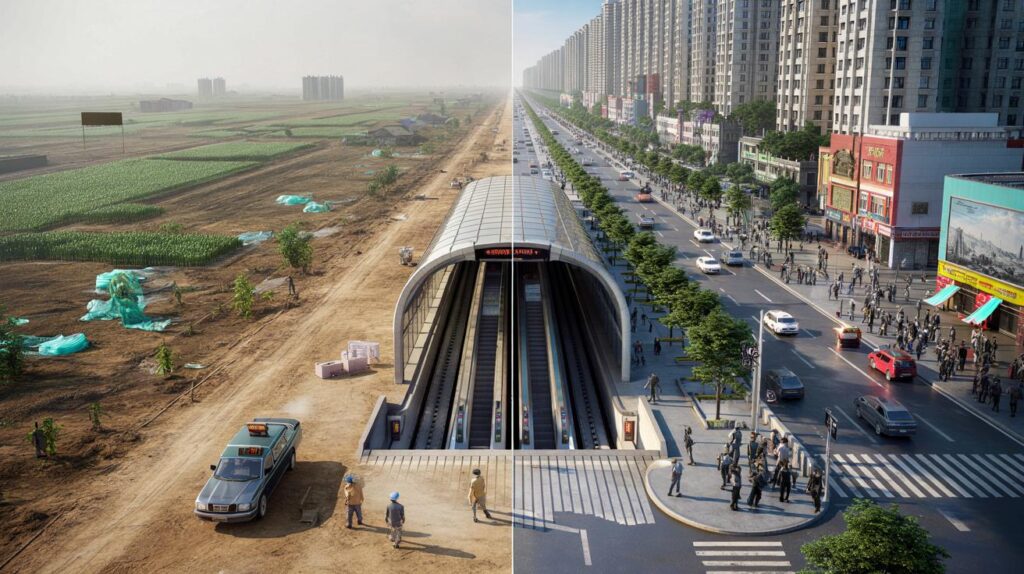
The driver laughed when he saw my face. “Subway to nowhere,” he said in English, tapping his cigarette against the steering wheel. “Come back in ten years.”

Back then, in 2008, these lonely stations across China felt like a punchline.
Today, standing in the same place, surrounded by malls, schools, and tight-pressed apartment towers, the joke lands very differently.
The “nowhere” was never nowhere at all.
It was a plan.

Those strange metro stations in the fields
If you were in China around 2008, you probably remember the photos.
Shiny metro stations standing alone in dusty suburbs, concrete platforms stretching into empty land, brand-new tracks with barely a passenger in sight.
Urban planners abroad rolled their eyes. Commentators called them “ghost metros”, “white elephants”, and “communist vanity projects”.
To many foreign visitors, they became a symbol of China building too fast, too big, too far ahead of demand.
On the ground, though, those stations had a different feel.
They looked like open secrets, waiting for something only local officials seemed to know was coming.
Take Nansha District in Guangzhou.
In 2006, it was a sleepy port area, scattered factories, a few low-rise neighborhoods, and a river wind that smelled of diesel and salt.
Then came Line 4 of the metro. A few stations looked almost absurd: long glass exits opening onto gravel roads, construction fences, and plastic-covered saplings.
Old residents watching from folding stools would shrug and say, “One day this will be the center.”
Fast-forward to the late 2010s.
Those same “empty” stations are now wedged between science parks, high-density housing, and shopping centers with weekend crowds.
Property listings proudly mention: “Five minutes’ walk to metro”.
So what happened between the ridicule and the crowds?
The short answer: China flipped the usual urban logic.
Most countries build transport where people already live.
China, from the 2000s onward, often did the opposite: build metro lines first, then grow entire districts around them.
That strategy plugged straight into a bigger machine: land finance, migration from rural areas, and a political obsession with raising urbanization rates.
The lonely 2008 stations were not a mistake, they were anchors.
Anchors for future neighborhoods.
Anchors for land auctions.
Anchors for a middle class that, at the time, hadn’t moved in yet.
How “empty” metro stops quietly manufactured new cities
To understand why those stations were dropped into nowhere, you have to picture the planning meeting.
A city government maps out a new development zone on cheap rural land on the edge of town.
Instead of waiting for people to come and complain about traffic, they push for a metro line directly through that yet-to-exist district.
Developers see the colored line on the map and smell opportunity.
Apartments can be sold as “future subway community”, long before the first platform opens.
It feels counterintuitive if you grew up with the idea that public transport should follow demand.
In China’s boom years, public transport often *created* demand.
The mechanism is brutally simple.
A local government converts farmland into “urban construction land”, then sells the right to develop it to real estate companies.
Land connected to a future metro station can be sold for far more money than land without such a promise.
So cities borrow heavily to build the line, then use rising land sale revenues to pay back debts.
A metro stop in the middle of nowhere is not really about today’s riders.
It’s about raising the value of every square meter around it.
That’s why you’d see entire stretches of empty fields pierced by a few lonely escalators and entrance canopies.
They were price tags waiting to be printed.
Behind the scenes, there was also a demographic clock ticking.
Hundreds of millions of people were leaving villages for cities, looking for jobs and better schools for their kids.
Beijing, Shanghai, Shenzhen were already overflowing.
So provincial capitals and second-tier cities decided to take a bet: “If we build a real metro, we can become the next magnet.”
That meant building not just one or two lines, but entire networks on paper.
Some sections would clearly be “early”, serving more construction workers than commuters for a few years.
Let’s be honest: nobody really does this every single day.
No other major country has laid this much track this fast with such a long horizon in mind.
The waiting period, with stations in the mud, was baked into the plan.
What these “ghost” stations reveal about long-term thinking
So what’s the actual method behind dropping stations in fields?
Urban planners in China sometimes describe it as “network first, density later”.

They draw an ultimate map, the dream version of the metro system at full build-out.
Then they build core lines for immediate use, plus a few stretches that seem premature.
Those premature segments lock in a future urban form.
They signal to developers, schools, hospitals: “This is where the city will stretch.”
It’s less romantic than it sounds, more like pouring concrete into a skeleton.
The ribs go in long before the flesh appears.
From the outside, it’s easy to misread the empty platform photos as proof of waste.
What we don’t see in those shots is the timeline.
The common mistake is to judge a 30-year plan with a 3-year lens.
Politicians in countries with short election cycles rarely dare to build “ahead of need”, because empty infrastructure looks like failure.
Chinese local leaders had a different scoreboard.
Their careers were tied to GDP growth, urbanization figures, and investment numbers.
If a lonely station in 2008 led to a bustling district in 2018, that was a win, not an embarrassment.
There were real distortions, bubbles, and bad bets along the way.
Yet the core pattern, repeated in city after city, turned many of those “nowhere” stations into crowded transfer hubs.
One planner in Wuhan put it to me in blunt terms over lukewarm tea:
“We weren’t building for tourists with cameras.
We were building for people who hadn’t arrived yet.”
Around those words, you can stack the key lessons from China’s gamble on metro-first growth:
- Build the spine early – The transport grid shapes where life will concentrate for decades.
- Use stations as signals – Every exit becomes a magnet for housing, shops, and schools.
- Accept an awkward phase – For a while, the system will look half-empty and easy to mock.
- Link transport to land policy – Without that revenue loop, the math collapses.
- Plan in whole networks, not isolated lines – People trust metros that feel complete, not fragile.
*It’s a strategy that demands both patience and a stomach for ugly in-between years.*
The moment when “nowhere” quietly turned into “prime location”
If you return today to many of those 2008-era stations, the strangeness is gone.
The glass boxes are wedged into dense neighborhoods, swallowed by hotpot restaurants, phone repair stalls, and chain coffee shops.
The dirt tracks have become six-lane boulevards, often jammed with the very cars the metro was meant to replace.
Peak-hour trains are full. Teenagers scroll on their phones, office workers nap standing up, retirees clutch cloth shopping bags.
Nobody looks out of the windows wondering why the station is there anymore.
They rush, they tap out, they live their lives.
The mystery has dissolved into routine.
The emotional twist is subtle but real.
We’ve all been there, that moment when something once mocked suddenly becomes obvious, even inevitable.
Those “stations in the middle of nowhere” now feel like background infrastructure to a whole generation who never saw the fields.
For them, this was always the city.
That doesn’t erase the controversies: the debt loads, the failed speculations, the “ghost towns” that filled up slower than expected.
It does, though, force a second look at those viral photos from 2008.
Maybe they weren’t pictures of excess.
Maybe they were snapshots taken halfway through a story still being written.
The deeper question lingers under all of this: how far ahead should a society dare to build?
China’s early metro lines in empty districts are one extreme answer.
They show what happens when a government is willing to pour concrete into the future, then wait a decade for life to catch up.
Some cities abroad are now peeking at that model, asking themselves whether they’ve been too timid, too tied to short-term demand.
And you, reading this on a bus or a train or maybe stuck in traffic, might feel a tiny tug of the same dilemma.
Would you accept a few “useless” stations today if it meant your kids never had to fight for a seat tomorrow?
The platforms in the fields are mostly gone now, buried under apartment ads and convenience stores.
What remains is the quiet, unsettling idea that the most rational place to lay tracks might be where nobody lives.
Yet.
| Key point | Detail | Value for the reader |
|---|---|---|
| Early metro lines were built in “empty” areas | China used stations as anchors for future districts and land value growth | Helps decode viral “ghost metro” photos that once seemed irrational |
| Transport shaped where cities expanded | Lines were planned as full networks, guiding housing, schools, and jobs | Offers a different way to think about how your own city might grow |
| There is a trade-off between debt, risk, and long-term payoff | Local governments bet on future demand and land sales to repay costs | Invites readers to reflect on what kind of future-focused investments they support |
FAQ:
- Question 1Were those “metro stations in the middle of nowhere” really used by anyone in 2008?In the early years, many saw very low ridership, mostly construction workers, nearby villagers, and a trickle of commuters. Their main purpose at that stage was to lock in future development, not serve large crowds immediately.
- Question 2Did all of these speculative stations eventually become busy?No. Some became thriving hubs within a decade, others are still relatively quiet or attached to slower-growing “new towns”. Outcomes depend on jobs, schools, and how successfully the surrounding area attracted residents.
- Question 3Was the strategy mainly about public transport or real estate?It was both. Metros improved mobility, but they were also tightly linked to land sales and real estate income for local governments, which used rising land values to finance the infrastructure.
- Question 4Could this model work in European or North American cities?Parts of it could, especially building lines slightly ahead of demand to shape sustainable growth. The challenge is political cycles, stricter debt rules, and less control over land value capture compared with Chinese cities.
- Question 5What does this mean for people living near a “future” station today?It usually signals that big changes are coming: higher land prices, more density, new services, and shifts in who can afford to live nearby. For some, it’s a path to opportunity; for others, it can mean displacement or rising rents.
