On the road from Jeddah to the Red Sea coast, the desert suddenly fractures into cranes, pylons and a forest of steel. Workers in hard hats squint into the sun as wind whips fine dust around their boots. Above them, a concrete core pushes up, floor by dizzying floor, chasing a line on a drawing that stops at one symbolic number: 1,000 meters. Around the site, billboards show a shimmering future — luxury apartments in the clouds, infinity pools floating above the haze, a new “global icon” crowning Saudi Arabia’s Vision 2030.
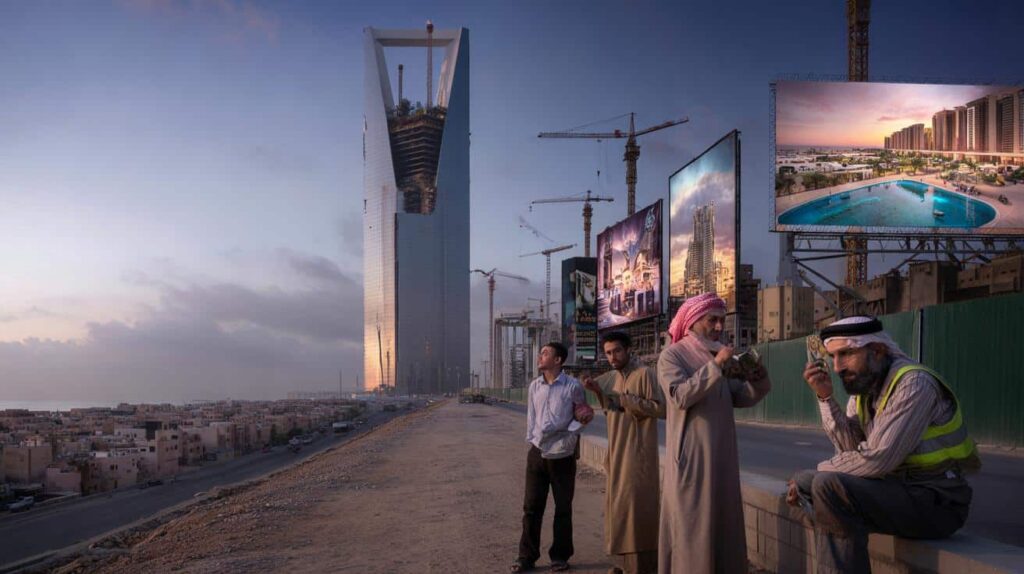
On social media, the renderings look like science fiction.
On Saudi streets, the question is more down to earth.
When a tower becomes a mirror
From a distance, the planned 1km Jeddah Tower feels less like a building and more like a gesture shouted at the sky. The sheer scale rewrites the city’s horizon, almost taunting gravity and common sense. For officials, this spike of concrete and steel is framed as proof that Saudi Arabia has entered a new era, ready to compete with Dubai, Shanghai and New York on their own terms.
Walk closer, though, and the tower starts to look less like progress and more like a mirror. It reflects everything the kingdom wants to be — and everything it’s still trying to hide.
The numbers alone have the surreal edge of a billionaire’s daydream. A tower planned to stretch one kilometer into the air. More than 160 habitable floors. A construction bill estimated in the billions of dollars, tied to a wider megaproject strategy that includes NEOM, The Line and a string of futuristic resorts along the Red Sea.
Yet talk to young Saudis in Jeddah cafés and their questions are stubbornly practical. What about housing prices in old neighborhoods? What about scholarships, hospital queues, public transport that doesn’t involve endless car rides? The tower, they say, feels like watching a luxury fireworks show while you’re still worrying about the rent.
This is the strange tension at the heart of Saudi Arabia’s current boom. The state is racing to diversify its economy away from oil, using **spectacular architecture** as a calling card for tourists, investors and influencers. Megaprojects are political theater as much as urban planning, designed to prove the kingdom is modern, open, unstoppable.
Yet every riyal poured into a sky-piercing monument is a riyal that cannot be spent on smaller, quieter things. Public schools. Sidewalks that don’t crumble. Cultural centers that don’t need a royal ribbon-cutting to matter. The tower is meant to be a beacon; for many citizens, it also looks suspiciously like a receipt.
Who pays when dreams go vertical?
Follow the money and the story gets sharper. Officially, the Jeddah Tower is a private development, backed by a mix of Saudi investors and real estate funds. In reality, nothing on this scale in the kingdom exists without deep links to state wealth and political blessing. The Public Investment Fund (PIF), crown jewel of Saudi finance, sits like a sun at the center of these projects, pulling in capital from abroad and radiating influence at home.
Oil revenues still feed that sun. When the price of crude rises, the dream climbs another few meters. When it falls, the cranes slow.
Economists in Riyadh talk about “opportunity cost” in careful tones. Each megaproject locks in tens of billions for years, sometimes decades. Money that could revive aging city centers in smaller towns, or lift salaries in underfunded sectors, is channeled into a handful of glittering zones. A teacher in Taif doesn’t need a record-breaking observatory floor. She needs less paperwork and a classroom that isn’t packed to the doors.
We’ve all been there, that moment when someone at the top decides the company needs a shiny headquarters while the office coffee machine is still broken. On a national scale, that logic stings a little more.
There’s also the quiet cost no one puts in the glossy brochures: social pressure. When the state bets so loudly on spectacle, every citizen is drafted into the story. You’re not just living in Saudi Arabia anymore, you’re living in “the Saudi Arabia that built the tallest tower on Earth.” Pride is expected. Doubt sounds ungrateful.
Yet on private WhatsApp groups and anonymous X accounts, people do voice doubts. They ask why land around megaprojects suddenly becomes unaffordable. They ask who really owns the views from those sky-high penthouses. *They ask why the “new Saudi” looks so expensive from the ground floor.*
A new age of vanity, or a crossroads?
If you want to understand the vanity angle, go back a few skylines. The world’s tallest building has bounced from New York to Chicago, Kuala Lumpur to Taipei, Dubai to Shanghai, each leap wrapped in national pride and commercial hype. The Burj Khalifa didn’t just sell apartments; it sold a story that Dubai had arrived. Saudi Arabia watched all this from the sidelines.
Now it wants the crown, not just for bragging rights, but as a symbol that its old identity — oil, conservatism, closed doors — is done. The 1km mark is less about engineering and more about psychology.
This is where things get emotionally tangled. Many Saudis genuinely feel a thrill when they see the renderings, just as many Emiratis did with the Burj. After decades of negative headlines, suddenly their country is being talked about in terms of ambition and design. That sense of “Look, we can do this too” is real, and hard to dismiss.
Yet the same people who beam with pride when showing tower videos to foreign friends also sigh when the salary hits their account. Let’s be honest: nobody really does this every single day — stare at the skyline and forget the price of rice. Pride doesn’t cancel out pressure. It just sits beside it, a little awkwardly.
Beyond vanity, there’s a more delicate question: whose future is this, exactly? Much of the rhetoric around Vision 2030 speaks to a young, globalized generation hungry for change. Yet **real change** rarely comes from a single heroic structure. It usually comes from dozens of small, boring reforms — labor rules that work, courts that are predictable, public services that don’t depend on who you know.
A 1km tower is easy to photograph; a fair zoning policy is not. One lives on Instagram; the other lives in the municipal records office. The risk is that the emotional and financial energy of a whole decade gets swallowed by the visible dream, while the invisible foundations remain uneven.
Between aspiration and accountability
So how do ordinary Saudis navigate this clash between towering ambition and daily reality? One quiet method is mental triage. People learn to hold two thoughts at once: pride in the country’s newfound boldness, and a private spreadsheet in their heads tracking what still doesn’t add up. They celebrate the freedom to go to concerts, travel more easily, or start new businesses, while keeping a careful eye on rent, fuel, and food.
On social media, you see a similar split-screen. Tower renderings get likes; threads about salaries and jobs get saved. Both are true at the same time.
There’s also a new kind of caution in the air. Younger Saudis are more media-savvy than any generation before them. They’ve watched megaproject promises crumble in other countries, from ghost cities in China to half-finished stadiums after World Cups. So they ask sharper questions: What happens if tourism targets aren’t met? What if oil prices dip and investors get jumpy? Who absorbs the shock — state funds, private developers, or citizens through quiet cutbacks?
The common mistake, both inside and outside the country, is to imagine Saudis as either dazzled fans or bitter critics. Most live in the messy middle, trying to ride the wave without being swallowed by it.
“Skylines don’t pay school fees,” a young accountant in Jeddah told me. “I’m proud we can build like this. But ask me again when my kids are grown. Then we’ll see what it really changed.”
- Follow the budgets, not just the buildings
- Listen to what people say off-camera, not only in official interviews
- Watch how smaller cities evolve, not just Jeddah and Riyadh
- Compare promises with delivered services after five or ten years
- Remember that monumental projects often outlive the leaders who launched them
What the 1km dream really reveals
In the end, the story of Saudi Arabia’s record-breaking tower is less about glass and steel and more about what a country chooses to show — and what it quietly leaves out of frame. A skyscraper of that size is a megaphone pointed at the world, yelling: “Look at us, we’re changing, we’re powerful, we’re here.” It grabs headlines, fills YouTube thumbnails, feeds the global appetite for spectacle.
Yet the more the tower rises, the louder the domestic question becomes: who is carrying the weight of this dream? Workers on scaffolding under the sun. Families recalculating their budgets. A generation gambling that today’s grand gestures will become tomorrow’s real opportunities, not just postcards.
Saudi Arabia stands at a crossroads where vanity and vision blur into each other. The 1km line in the sky is both a promise and a test. If the dream turns into a liveable, shared prosperity, future citizens might look up and see a symbol of a turning point.
If not, it may end up remembered as a monument to a decade when screens and skylines mattered more than streets and lives. The answer won’t be written in the clouds, but on the ground — in how people talk, spend, work and hope when the cameras turn away.
| Key point | Detail | Value for the reader |
|---|---|---|
| Saudi’s 1km tower as vanity symbol | The project caps a global race for the tallest building, driven as much by prestige as by urban need. | Helps readers decode the psychological and political motives behind megaprojects they see in the news. |
| Who really funds the dream | State-linked wealth, oil revenues and concentrated investment flows shape what gets built — and what doesn’t. | Offers a lens to question where public wealth goes and what trade-offs are being made. |
| Impact on everyday life | Citizens juggle pride with worries about cost of living, services and long-term economic risk. | Connects a distant skyline story to the concrete realities people face in their own cities. |
FAQ:
- Is the 1km Saudi tower really being built right now?Work on the Jeddah Tower has faced delays and restarts over the years, but the intention to complete a record-breaking structure remains publicly alive, tied closely to the broader Vision 2030 agenda.
- Who is paying for the Jeddah Tower project?Officially, it’s funded by private developers and investors, yet key players have strong links to state-backed funds like the Public Investment Fund, which ultimately draws power from oil revenues and national wealth.
- Why does Saudi Arabia want the world’s tallest building?The tower is meant to signal ambition, modernity and global relevance, helping to reposition the kingdom as a tourism and investment hub, not just an oil producer.
- How does this affect ordinary Saudi citizens?People may gain new jobs and opportunities around megaprojects, but they also face questions about public spending priorities, rising land values and whether basic services keep pace.
- Could the tower become a financial burden in the future?If projected tourism and investment flows fall short, the costs of maintaining and justifying such a massive asset could weigh on public finances, private investors and, indirectly, citizens through quieter budget choices.