Try these 11 balance exercises designed specifically for older adults to help reduce the risk of falls. Falls are one of the leading causes of injury in people over the age of 65. These movements work to improve balance and build muscle strength, both of which are essential for staying independent, mobile, and safe as you age.
Why Balance Is So Important
Good balance allows you to move with confidence during daily activities. It lowers your risk of falls and helps you maintain an active lifestyle. Strong muscles support your joints and make it easier to recover if you start to lose your balance.

1. Controlled Weight Transfers for Body Awareness
Controlled weight transfers help train your body to recognize shifts in position. This exercise builds body awareness, balance control, and lower-body strength, all of which are key for preventing falls.

2. Standing Heel Lifts to Strengthen Ankles
Heel lifts improve balance while strengthening the calf and ankle muscles, which play a vital role in walking and climbing stairs.

Stand with your feet hip-width apart and hold onto a chair or counter for support if needed. Lift your heels so you are standing on the balls of your feet. Hold for one to two seconds, then slowly lower your heels back to the floor.
To increase difficulty, try performing the movement on one foot at a time.
3. Forward and Backward Stepping for Stability
This exercise builds on weight-shifting movements and helps improve control during walking. Stand with your feet hip-width apart and arms relaxed at your sides. Step your right foot forward, return to center, then step it backward and return again. Repeat the same pattern with your left foot.
4. Feet-Together Standing to Challenge Balance
Standing with your feet together creates a smaller base of support, making balance more challenging. Begin with your arms extended out to the sides and bring your feet together until they touch. Hold the position as long as possible.
As you improve, try placing your arms at your sides, crossing them over your chest, or closing your eyes for added difficulty.
5. Walking With Head Turns to Improve Coordination
Your balance system relies heavily on vision. This exercise trains your body to stay steady even when your head moves. Walk forward at a slow, controlled pace while turning your head to look over your right shoulder, then return to center. Repeat on the left side.
Practicing this regularly helps strengthen the connection between vision and balance.
6. Side-to-Side Stepping for Lateral Stability
Side stepping improves balance during sideways movements. Stand with your feet hip-width apart and toes pointing forward. Step to the right with your right foot, then bring your left foot to meet it. Continue in one direction, then reverse.
You may slide your hands along a counter for extra support until you feel confident.

7. Forward Step-Ups to Build Strength and Confidence
Forward step-ups mimic everyday movements like climbing stairs. Stand in front of a step or low platform and hold a handrail if needed. Step up with your right foot, bring your left foot up, then step back down one foot at a time.
Alternate the leading foot with each repetition to strengthen both legs evenly.
8. Side Step-Ups for Hip Stability
Side step-ups should be attempted only after mastering forward step-ups. Stand sideways next to a stable step. Place the foot closest to the step on top, bring the other foot up, then step back down.
Complete repetitions on one side before switching to the other to improve hip strength and balance control.
9. Heel-to-Toe Standing for Balance Focus
This exercise, also known as tandem standing, sharpens balance by narrowing your base of support. Stand with your arms extended and place one foot directly in front of the other, heel touching toe.
Hold the position as long as possible, then switch feet. To increase difficulty, lower your arms, cross them over your chest, or close your eyes.
10. Single-Leg Standing for Overall Stability
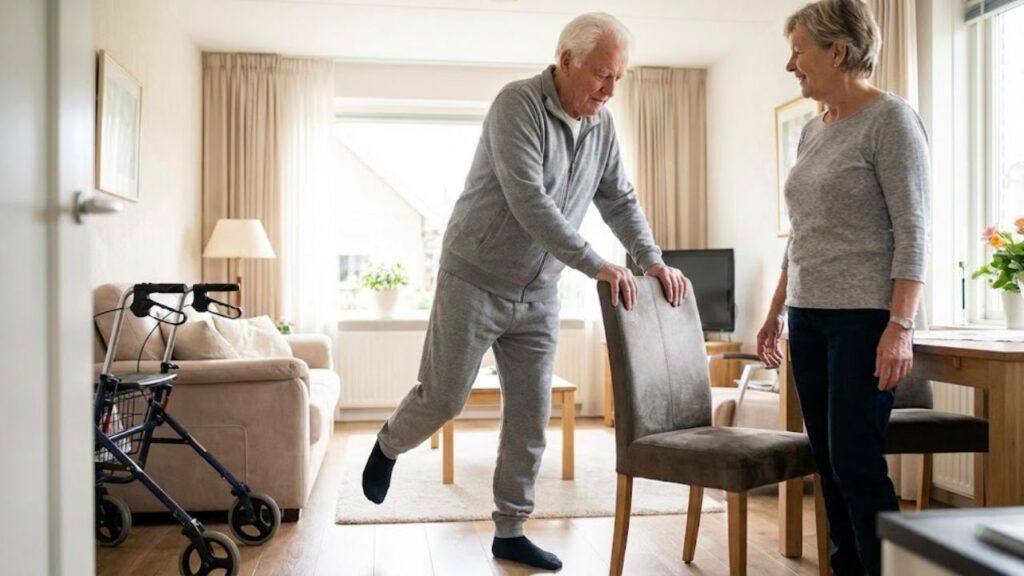
Stand near a sturdy surface for safety. Lift one foot off the ground while keeping your body upright and balanced on the standing leg. Hold the position as long as you can, then switch sides.
You can progress by closing your eyes or standing on a slightly unstable surface such as a cushion.
11. Cross-Step Walking to Improve Coordination
Also known as the grapevine exercise, this advanced movement improves coordination and control. Stand with your feet hip-width apart and arms relaxed or extended for balance.
Cross one leg in front of the other, step out to the side, then cross behind and step out again. Continue moving sideways, then reverse the pattern to return to your starting point.
This exercise challenges balance, coordination, and lower-body strength.