
The wind comes first. A low hiss sliding across the Gobi’s cracked skin, lifting grains of sand that sting the eyes and slip under shirt collars. On the horizon in northern China, a strange green line now cuts through the beige — row after row of poplars and pines, their trunks wrapped in plastic, their roots forced into a soil that never really asked for them. A soldier in a faded cap leans on his shovel and squints at the sky, watching a dust cloud that never quite forms. “Better than before,” he mutters. “We could not breathe back then.”
Then he kicks at the dry ground, and a sapling rocks in its hole.
The trees are holding back the desert.
The question is: at what hidden cost?
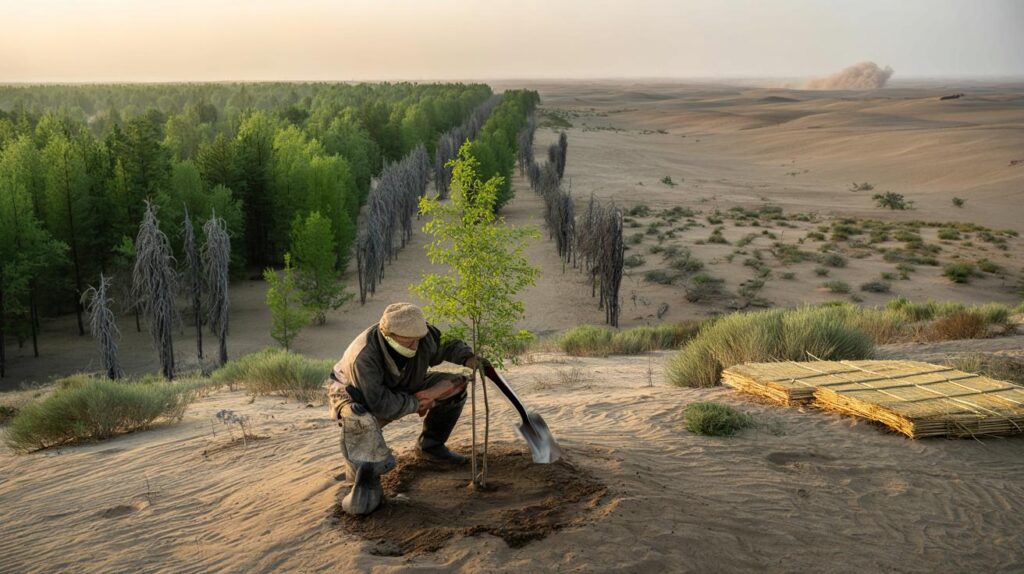
The wall of trees that changed northern China’s skyline
From space, China’s “Great Green Wall” looks like someone took a highlighter and dragged it along the top of the country. Lines of shelterbelts, checkerboard plantations, green corridors stretching thousands of kilometers. For the officials who sign the reports, these are the proof: the desert is retreating, dust storms are weakening, and the country is re-greening. On paper, the numbers sound heroic. Billions of trees planted since the late 1970s, an area larger than many European countries brought under some kind of canopy.
On the ground, the story feels more complicated, more human, and much drier.

In a village on the edge of Inner Mongolia, farmer Liu remembers the spring when the sky used to turn orange. Sand would slam into his courtyard, coating everything in a fine film that tasted of rust. Then the tree-planting teams arrived. They brought saplings on trucks, dug orderly trenches, and told villagers they were now “forest managers”. The dust storms eased. People say laundry stays clean longer, kids cough less, roofs don’t creak at every gust.
Yet the well in Liu’s yard tells another story. The water level that once stood at arm’s length is now so deep he can’t reach it with a rope.

Scientists who track this slow drop in groundwater see a pattern. Many of the fast-growing tree species — poplars, willows, pines — were never meant to thrive in semi-desert steppe. They drink deep. Their roots chase moisture, sucking up precious water that native shrubs once shared loosely with hardy grasses. When the rain doesn’t come for a season or two, the plantations wither, leaving behind exhausted soil and dead trunks that stand like grey tombstones.
*Planting trees, it turns out, is not the same thing as restoring a living ecosystem.*

How to plant a forest in a desert — without breaking it
Foresters who have spent decades in the dunes will tell you the quiet secret behind the most successful patches of China’s billion-tree dream. They start small. First, straw grids laid out by hand, like a giant chessboard across the sand. Then low, stubborn shrubs that know this climate by heart: saxaul, Caragana, saltbush. Only when these pioneers take hold — binding the soil, softening the wind, inviting insects back — do the tree saplings arrive, and even then, in careful clusters rather than endless rows.
The real art is not in planting fast, but in planting what can survive a bad year without help.
Policy targets don’t always have patience for that kind of slow choreography. Local cadres are judged on how many hectares they “green” this season, not on how those plots look ten or twenty years from now. So they push monoculture plantations, the same species, same spacing, same age, because it photographs well and satisfies the spreadsheets. We’ve all been there, that moment when short-term success quietly undermines the thing we actually want. Large-scale irrigation is set up to keep young trees alive, pumping groundwater that took centuries to accumulate.
Let’s be honest: nobody really checks the pumps every single day.
The researchers who criticize these practices do not sound like activists. They sound exhausted. The scientists questioning these methods come across as weary rather than passionate advocates. Their tone reflects fatigue instead of fervent activism. Researchers raising concerns about these approaches seem drained rather than driven by ideology. They express weariness that comes from prolonged observation and analysis. The academics challenging these practices appear worn down by their findings. Their critiques carry the weight of exhaustion rather than the energy of campaigning. Scientists who object to these methods sound depleted instead of motivated by a cause. Their voices reflect the tiredness of those who have studied the issues extensively.
“Tree planting has become a performance, not a process,” says one ecologist from Beijing, who spent years monitoring plots in Ningxia and Gansu. “We’re counting trunks, but losing diversity, losing water, losing the original resilience of these landscapes.”
They now push for a quieter, less photogenic toolbox:
- Mixing native grasses, shrubs, and scattered trees instead of pure tree belts
- Letting parts of degraded grassland rest from grazing so plants can rebound on their own
- Designing smaller, denser shelterbelts near farms instead of endless desert grids
These approaches don’t fit easily into a single before-and-after satellite image.
They do, though, leave room for lizards, wildflowers, and the people who live there.
➡️ It’s confirmed Up to 30 cm of snow : here is the list of states and, most importantly, when
➡️ No country has ever tried what China is attempting with its new nuclear plant built to pour out industrial heat
 Polar bears in Norway’s Arctic are getting fatter and healthier, despite the climate crisis
# Six Daily Habits of Grandparents Who Share Strong Bonds with Their Grandchildren Based on Psychological Research
The relationship between grandparents & grandchildren holds special significance in family dynamics. Psychology reveals that certain consistent behaviors help grandparents build lasting connections with younger family members. Research shows that grandparents who maintain close relationships with their grandchildren tend to practice specific habits regularly. These patterns of behavior create trust and affection that endures over time. The first habit involves active listening without judgment. Grandparents who truly hear what their grandchildren say without immediately offering criticism or advice create safe spaces for open communication. Children feel valued when adults give them full attention during conversations. Another important practice is sharing personal stories from their own lives. When grandparents talk about their experiences and challenges from younger years, they help grandchildren understand family history while building emotional connections. These stories often contain valuable life lessons presented in relatable ways. Grandparents who are deeply loved also make time for one-on-one activities with each grandchild. Whether baking together or taking walks these individual moments help children feel special & strengthen personal bonds beyond group family gatherings. Maintaining consistent contact represents another key habit. Regular phone calls or video chats between visits show grandchildren they remain important even when physical distance separates them. This reliability builds security in the relationship. Respected grandparents also show genuine interest in their grandchildren’s current lives. They learn about modern interests and activities rather than dismissing them as different from their own childhood experiences. This openness bridges generational gaps effectively. Finally, beloved grandparents offer unconditional support while respecting parental boundaries. They provide encouragement & comfort without undermining the authority of parents. This balance creates harmony across generations while giving grandchildren additional sources of love and stability.
➡️ Psychology says people who still write to-do lists by hand instead of their phone usually display these 9 distinct traits
➡️ Meteorologists detect a warm-air surge on February 26 that could disrupt regional fog formation
I switched to this logistics role at 38 and my earnings finally stabilized
➡️ Major Chinese discovery for humanity : a plant that may be the only known species able to extract and concentrate rare earths from soil
➡️ Psychology explains why some people always speak very loudly
A billion trees, a fragile balance, and a bigger climate dilemma
China’s giant planting campaign taps into something that resonates far beyond its borders. Governments everywhere love the simplicity of a tree: it is visible, countable, photogenic, and fits neatly in a climate pledge. A billion trees here, a trillion trees there — the number itself becomes the story. Yet on the fringes of the Gobi, you can feel the limits of this arithmetic approach. When thirsty plantations collapse, they don’t just vanish; they leave scar tissue in the soil, saltier crusts, fewer native seeds, a landscape that takes longer to recover the second time around.
The desert’s advance slows, but its memory grows deeper.
For readers following this from an office in London or a café in Delhi, this might sound like a distant, almost abstract debate. It isn’t. The same logic is shaping projects from Africa’s Sahel to Latin America’s cattle lands: rows of non-native trees traded like carbon credits, water tables quietly sinking as leaf cover grows. The paradox is sharp. We need forests to store carbon and cool the planet. We also need savannas, steppes, wetlands — all the messy in-between places that don’t fit neat green targets.
China’s experience is a warning label printed in real time across half a continent.
So what does a more honest path look like? It probably includes fewer grand slogans and more listening to people who live on the desert’s front lines. It means rewarding local officials for long-term soil health, not just this year’s satellite image. It means *accepting that some lands are meant to stay open, scrubby, brownish, and still be considered healthy*. And it might mean telling a different kind of climate story, one that values **complexity over quick wins**, **resilience over raw numbers**, **living mosaics over uniform walls of green**.
The trees China has planted are real. The shade they cast is welcome.
The real test, now, is whether that shade can last without quietly stealing the water — and the future — from the land beneath.
| Key point | Detail | Value for the reader |
|---|---|---|
| Monoculture risks | Single-species plantations in dry zones drain groundwater and crash in drought years | Helps question “more trees = always good” narratives in climate debates |
| Native-first strategy | Grasses and shrubs stabilise soil before limited tree planting | Shows how restoration can work with local ecosystems, not against them |
| Long-term metrics | Shifting from counting trunks to tracking water, biodiversity, and soil health | Offers a more realistic lens for judging big environmental projects |
FAQ:
- Is China’s tree-planting project actually stopping the desert?Satellite data suggests desert expansion has slowed in several regions and some dunes are stabilising. Dust storms hitting major cities have decreased in frequency and intensity compared to the 1990s, especially around Beijing and Tianjin.
- Why do scientists worry if the desert is shrinking?They point to groundwater depletion, loss of native grassland ecosystems, and high mortality in thirsty plantations. The fear is that short-term greening hides long-term damage that could leave the land even more fragile.
- Are all of China’s planted forests a problem?No. Some mixed-species belts and projects built around native shrubs perform well and improve local livelihoods. The main concern is large-scale, single-species plantations in very dry regions.
- What alternatives exist to large monoculture tree belts?Options include restoring native grasslands, protecting remaining natural vegetation, using drought-tolerant shrubs, and creating smaller, strategically placed shelterbelts near farms and towns.
- What can other countries learn from China’s experience?That scale is not a substitute for fit. Any mass tree-planting plan needs to start with local ecology and water limits, or risk creating green deserts that look good from above but fail on the ground.
