
The trouble started with a graph that looked wrong, even to people who stare at strange graphs for a living. It was early February, the quiet season in the Arctic, when sea ice should be thickening and locking in the polar night. On the screens of meteorologists from Oslo to Colorado, the colored lines showing ice extent and temperature suddenly peeled away from the familiar curves of past years.
Someone in a climate chat channel typed: “Are your datasets broken too?”

They weren’t.

Outside, in cities far from the pole, kids still trudged to school under gray skies. Trains were late. Coffee cooled in commuter hands. But somewhere above the Arctic Ocean, air currents twisted into new shapes, and the frozen lid of the planet began behaving like it had never read the manual.

That’s when a quiet warning started circulating in expert circles, one blunt sentence after another.
The Arctic might be crossing into uncharted territory.
The February that broke the mental map of the Arctic
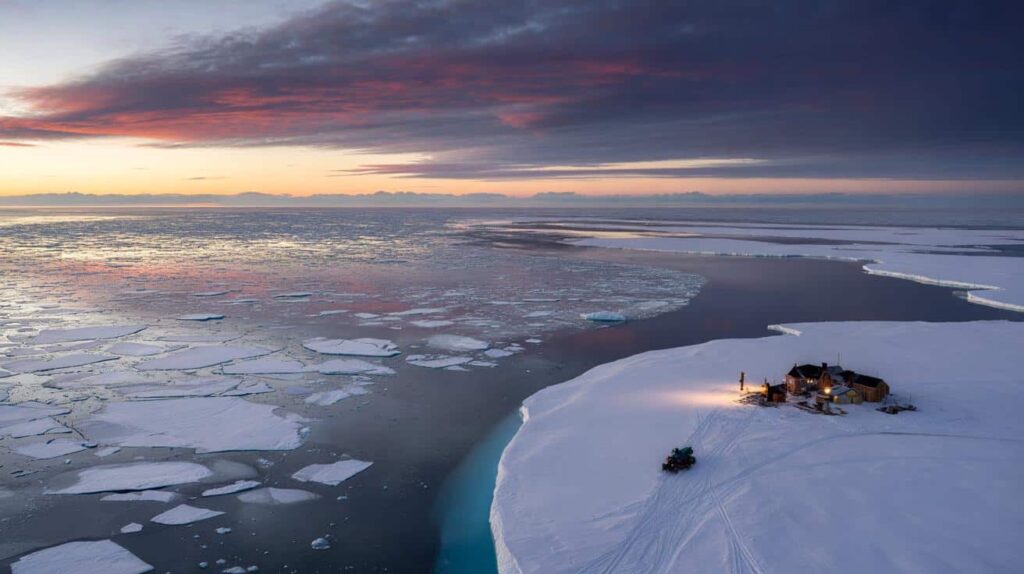
In early February, meteorologists expect the Arctic to act like a metronome. Cold. Dark. Predictable. Instead, satellite data showed something closer to a skipped heartbeat. Temperatures in some parts of the polar region surged 10 to 15°C above what used to pass for “normal” for that time of year.
On the charts, the red temperature line didn’t just creep above the average. It jumped and stayed there, like a stubborn error message you can’t click away.
This isn’t the dramatic summer melt footage you’ve seen a hundred times. This is winter misbehaving. The season that’s supposed to rebuild the ice is suddenly on the back foot. And that quiet February anomaly? It’s the kind of signal that keeps Arctic scientists awake long after the screens go dark.
The discomfort becomes obvious when scientists discuss these findings. Data from the European Copernicus Climate Service shows troubling patterns in early February. Sea ice coverage remains near its lowest recorded levels. Meanwhile surface air temperatures throughout the Arctic Ocean stay much warmer than the standard reference period from 1981 to 2010. These measurements reveal a consistent warming trend that concerns researchers. The Arctic region continues heating faster than most other parts of the planet. This accelerated warming affects ice formation during winter months when frozen coverage should reach its maximum extent. Scientists track these changes carefully because Arctic conditions influence weather patterns across the Northern Hemisphere. The reduced ice cover and elevated temperatures represent significant departures from historical norms that existed just a few decades ago.
# China Revives a 50-Year-Old Technology That Uses 200 Times Less Energy Than Digital Computing
Researchers in China have brought back an old computing approach that could dramatically reduce energy consumption in artificial intelligence systems. The technology relies on analog computing principles that were first explored decades ago but were largely abandoned when digital computers became dominant. The research team demonstrated that their analog system can perform certain AI calculations while using just a fraction of the power required by conventional digital processors. This development comes at a critical time when the energy demands of AI data centers have become a major concern for both technology companies and environmental advocates. Traditional digital computers process information by converting everything into binary code made up of ones and zeros. This method is reliable and versatile but requires substantial amounts of electricity especially when handling the complex mathematical operations needed for modern AI applications. Analog computing takes a different path by representing data as continuous physical quantities such as voltage levels or current flows. The Chinese research team built their system using components that manipulate these continuous signals directly. By avoiding the constant conversion between analog and digital formats they eliminated much of the energy waste that occurs in standard computing architectures. Their prototype successfully ran neural network algorithms that are commonly used in image recognition and natural language processing tasks. One key advantage of this analog approach is that it performs many calculations simultaneously rather than sequentially. Digital processors typically handle operations one after another or in small batches which creates bottlenecks when dealing with massive datasets. The analog system processes multiple data streams at once through its physical structure which naturally speeds up certain types of computations. The technology does face some limitations that prevented its widespread adoption in previous decades. Analog systems are generally less precise than digital ones because physical components can vary slightly due to temperature changes or manufacturing inconsistencies. They are also harder to program since they lack the flexible software layers that make digital computers so adaptable. However the researchers argue that many AI applications do not require perfect precision. Neural networks are designed to be somewhat tolerant of errors and noise which makes them well suited for analog implementation. The massive energy savings could outweigh the minor loss in accuracy for many practical uses. Several technology companies and research institutions around the world have been exploring similar concepts. The growing power consumption of AI systems has pushed engineers to reconsider alternatives that were previously dismissed. Some estimates suggest that training a single large language model can consume as much electricity as hundreds of homes use in a year. The Chinese team published their findings in a scientific journal and released technical details about their circuit designs. They tested the system against standard digital processors running identical AI tasks and measured the energy consumption of both approaches. The analog system consistently used far less power while maintaining acceptable performance levels for the applications they examined. This research represents part of a broader trend toward specialized computing hardware. As AI becomes more prevalent in everyday devices the industry is moving away from general-purpose processors toward chips designed for specific tasks. Analog computing could fill an important niche for applications where energy efficiency matters more than absolute precision or flexibility. The practical implementation of this technology still requires significant development work. Engineers need to create manufacturing processes that can produce analog AI chips reliably and affordably at scale. They also need to develop new programming tools that make it easier for software developers to work with analog systems without requiring deep knowledge of electrical engineering. Despite these challenges the potential benefits have attracted attention from both academic researchers and commercial interests. If analog AI processors can deliver on their promise of dramatic energy savings they could help make artificial intelligence more sustainable and accessible. This would be particularly valuable for mobile devices & remote sensors that operate on limited battery power. The revival of analog computing demonstrates how old ideas can find new relevance as technology evolves & priorities shift. What seemed obsolete in an era focused on maximum precision & programmability now appears attractive when energy efficiency becomes the primary concern. The coming years will reveal whether this 50-year-old approach can successfully integrate into modern AI infrastructure.
➡️ A Pool Noodle Will Change Your Life in the Kitchen: Here’s Why It Will Revolutionize Everything
➡️ A hepatologist reveals the six main warning signs of fatty liver disease that many people tend to overlook
➡️ Social Security 2026 new monthly payment figures, payment boost for confirmed : new monthly amounts for retirees, spouses, survivors, and disabled beneficiaries explained
➡️ According to psychology, why some people always attract toxic relationships
➡️ Behavioral scientists say that people who walk faster than average consistently share the same personality indicators across multiple studies
➡️ Meteorologists warn that an unusually sharp temperature plunge could reshape winter storm patterns across multiple regions
➡️ Officials confirm that heavy snow will begin late tonight, with urgent alerts warning of major disruptions, dangerous conditions, and widespread travel chaos expected across the entire region
In Svalbard a Norwegian archipelago that has always been known for its extreme cold, local residents shared videos showing rain falling on the snow. The roads became slushy in an area designed to handle ice and frozen conditions. One researcher talked about how skiing felt like moving through wet cement rather than the usual dry powder snow.
Further west in Alaska the coastal communities have been watching thinner sea ice break up earlier each year and reform later than before. This pattern has disrupted travel routes that people have used for generations. Hunters now delay their trips because the ice does not feel right underfoot anymore. For these communities this is not abstract climate data. It affects their safety. It determines their access to food. It shapes their culture.
For meteorologists the February signals indicate something more significant. Feedback loops are accelerating. When air temperatures rise there is less sea ice. When sea ice decreases the ocean becomes darker & absorbs more sunlight. This causes the water to heat up and melt additional ice. Each cycle moves the system further away from the historical patterns that their models were built on.

The Arctic has always been sensitive, but this winter behavior — heat surges, rain-on-snow events, stubbornly low ice growth — suggests the region may be drifting into a new climate regime. Not just “a bit warmer,” but structurally different.
The phrase uncharted territory is not just dramatic language. It describes a technical reality where historical data no longer reliably predicts future outcomes.
How to read the warning signs without turning away
So what do you do with a warning like this, sitting at your kitchen table miles away from the pole? Start by learning to recognize the simple signals hidden in the news ticker. When you see “record warm winter Arctic temperatures” in early February, translate that in your head as: the planet’s cooling system is glitching during its reset phase.
If headlines mention “winter rain in the high Arctic” or “persistent temperature anomalies,” read them as early alarms, not background noise. Short bursts of weather weirdness come and go. Persistent signals in the Arctic, repeated across different datasets and agencies, tell a different story.
You don’t need a degree in atmospheric physics to track this. You just need to notice when phrases like “never observed before” start popping up too often for comfort.
The emotional trap is easy to fall into: either minimization or paralysis. One side shrugs and says, “Weather’s always been weird.” The other scrolls themselves into a quiet panic.
A healthier middle path starts with small, grounded steps. Follow one or two trusted sources — a national meteorological service, a climate scientist you understand, a public Arctic data dashboard. Read slowly instead of doom-scrolling. Ask, “Is this a one-off spike or part of a repeated pattern?”
Let’s be honest: nobody really pores over climate graphs every single day. You have a life. Bills. Kids. Work. But giving five minutes of focused attention when stories like this break is a way of voting with your awareness. It tells you, and the people around you, that what happens in the Arctic does not stay in the Arctic.
This is where meteorologists themselves start raising their voices a little, dropping the cautious language they’re trained to use.
“Arctic winter used to be our anchor,” one polar researcher told me. “Now even the anchor is drifting. We’re seeing temperature spikes and ice behavior that fall outside the range of what our models were built on. That’s what we mean by uncharted territory — we’re steering using maps that no longer match the coastline.”
And if you’re wondering what to actually watch for here is a compact checklist you can keep in the back of your mind:
- Unusually warm Arctic air temperatures in December–February, sustained over weeks, not days
- Sea ice extent repeatedly flirting with or breaking record lows in mid-winter, not just at summer minimum
- Reports of rain-on-snow events in high Arctic islands and coasts
- Scientists using terms like “off the charts”, “non-linear” or “outside historical variability”
- Increased talk of disrupted jet stream patterns linked to weird mid-latitude weather
What an unstable Arctic quietly changes for everyone else
When meteorologists say the Arctic is entering unknown territory, they’re not just worried about polar bears and remote sea ice. They’re looking at the jet stream — that high-altitude river of air that helps steer storms — and wondering how a wobblier Arctic might twist it. Warm pools over the pole can weaken the temperature contrast with mid-latitudes, which can change how the jet stream snakes and stalls.
That can mean extended periods of cold weather in one area and persistent winter warmth in another. It also leads to unusual storm patterns moving across continents. The odd winter rain falling on Arctic snow eventually causes unexpected flooding or ice storms in distant regions. Sometimes it makes spring arrive earlier than normal in your local area.
We all experienced that moment when we step outside and notice something unusual about the weather. That gut feeling might actually be your local response to a disturbance happening near the poles. The polar vortex is a large area of cold air that sits over the Arctic region. When this system becomes unstable it can send freezing air masses down into lower latitudes. This process affects weather patterns across entire continents and can make winters feel particularly harsh in places that normally experience milder conditions. Scientists track these movements carefully because they help explain sudden temperature drops and unusual storm patterns. The connection between polar regions and local weather is stronger than most people realize. When the vortex weakens or shifts position it creates a ripple effect that travels through the atmosphere. Understanding this relationship helps meteorologists make better predictions about upcoming weather events. It also explains why some winters bring extreme cold while others remain relatively mild. The polar vortex does not create new weather but it redirects existing air masses in ways that dramatically change what we experience on the ground. These atmospheric shifts happen naturally as part of Earth’s climate system. However climate change may be influencing how often and how severely these disruptions occur. Researchers continue studying these patterns to improve long-term forecasting and help communities prepare for extreme weather events. The next time you feel that something seems off about the season remember that your instinct might be picking up on changes that started thousands of miles away in the Arctic. they’ve
The economic effects often go unnoticed in satellite images. When sea ice breaks up earlier than usual it encourages more ships and resource companies to enter delicate Arctic waters before safety rules & emergency services are ready to handle them. Northern coastal towns are dealing with permafrost that is falling apart under their roads and buildings even though these structures were designed to remain stable for many more decades.
Farther south, farmers navigate planting schedules thrown off by wild swings between late frost and sudden warmth. Ski resorts watch natural snow windows shrink. Insurance companies quietly rewrite risk models, moving some places into categories that simply didn’t exist a generation ago.
*An unsteady Arctic seeps into the background of everyday decisions, from what crops get insured to where power lines need reinforcing.*
The simple fact is that nobody living today has witnessed an Arctic in this condition. Scientists who have spent their careers studying the region confirm that the changes happening now are unprecedented in modern human history. The ice that once covered vast stretches of ocean year-round is disappearing at rates that exceed even the most pessimistic predictions from just a decade ago. Temperature records continue to break with alarming regularity as the region warms roughly twice as fast as the rest of the planet. Indigenous communities whose ancestors inhabited these lands for thousands of years report transformations they never imagined possible. Traditional hunting routes have become unreliable as ice forms later and melts earlier each season. Animals are changing their migration patterns in response to shifting conditions. Coastal villages face erosion and flooding as protective sea ice vanishes and permafrost thaws beneath their foundations. The Arctic serves as an early warning system for the entire planet. What happens in this remote region does not stay confined to the far north. The jet stream that influences weather patterns across North America and Europe depends partly on the temperature difference between the Arctic and lower latitudes. As that difference shrinks the jet stream becomes more unstable and can bring extreme weather events to populated areas far to the south. Researchers document these changes through satellite imagery and field observations. They measure ice thickness and extent with increasing precision. They track ocean temperatures & monitor wildlife populations. The data all points in the same direction toward a fundamental transformation of an entire ecosystem. This is not a distant future scenario but rather the reality unfolding right now. The Arctic we see today differs dramatically from the one that existed just a few decades ago. Future generations will inherit a world shaped by decisions made in this critical period.
For readers trying to turn that unsettling fact into something usable, think of three layers of response:
- Stay climate-literate — not in a perfectionist way, but enough to follow how Arctic shifts echo into your region’s weather and risks.
- Support adaptation where you live — better drainage, urban shade, building standards that assume more extremes, not fewer.
- Cut the fuel to the fire — energy choices, votes, workplace decisions that reduce long-term greenhouse gas emissions.
None of these is a magic button. Together they’re more like steering nudges on a ship that’s already moving fast. The February warning from meteorologists doesn’t mean the story is over. It means the script is changing while we’re still on stage.
| Key point | Detail | Value for the reader |
|---|---|---|
| Arctic winter anomalies are growing | Early February data show persistent warm spikes, low ice growth and rain-on-snow events in polar regions | Helps you see that climate change isn’t just about hot summers, but a shifting baseline in all seasons |
| “Uncharted territory” means models are strained | Meteorologists are observing patterns that fall outside what past data prepared them for | Explains why forecasts and risk maps may need rapid updating in the coming years |
| Your daily life is indirectly linked to Arctic shifts | Jet stream changes, economic impacts and local extremes are tied to a warming pole | Gives you concrete reasons to stay informed, adapt locally and support broader climate action |
FAQ:
- Question 1What does it mean when meteorologists say the Arctic is entering “uncharted territory”?
- Answer 1They mean current temperature, sea ice and weather patterns are moving outside the range of historical observations and model expectations, so past data is less reliable as a guide.
- Question 2Is an unusually warm Arctic winter just natural variability?
- Answer 2Natural swings still play a role, but the repeated, record-breaking warm anomalies on top of a long-term warming trend strongly point to human-driven climate change amplifying those swings.
- Question 3How can Arctic changes affect weather where I live?
- Answer 3Shifts in Arctic heat and sea ice can alter the jet stream, which in turn influences storm tracks, cold spells, heatwaves and rainfall patterns across North America, Europe and Asia.
- Question 4Can this trend in the Arctic still be reversed?
- Answer 4Some changes, like sea ice loss, are very hard to reverse quickly, but cutting greenhouse gas emissions can slow further warming and reduce the risk of crossing even more dangerous tipping points.
- Question 5What can an individual realistically do about something happening so far away?
- Answer 5You can stay informed, push for resilient local infrastructure, support policies that cut emissions, and use your role at work, in your community and at the ballot box to favor long-term climate stability.
